





I was today years old when I realized the deeper meaning of a text I’ve read my whole life. That’s the point of rereading the Torah, isn’t it? Every year, it hands you a new thread, and suddenly, your whole mindset changes.
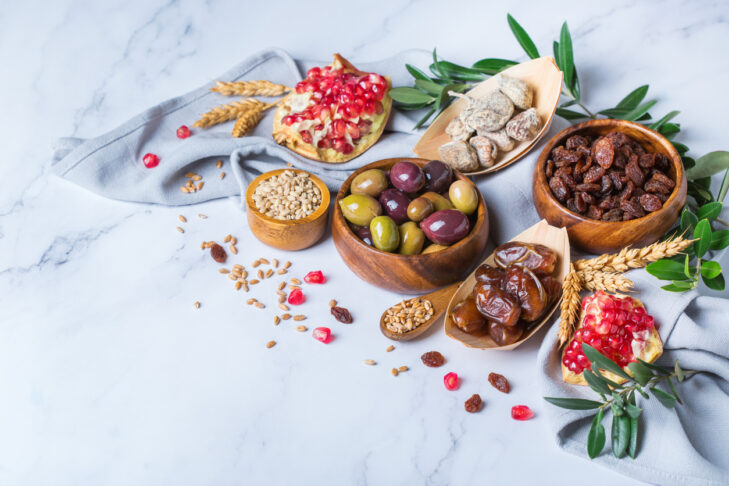
This week, Ki Tavo opens with a curious ritual: bikkurim, the offering of first fruits. Farmers in ancient Israel were told to harvest the earliest ripened produce of the Seven Species (wheat, barley, grapes, figs, pomegranates, olives, and dates), place them in a basket, and bring them to Jerusalem. Once there, they’d hand them to a priest and recite a short speech:
“My father was a wandering Aramean. He went down to Egypt… The Egyptians mistreated us… The Lord brought us out with a mighty hand… He gave us this land, a land flowing with milk and honey. And now I bring the first fruits of the soil You have given me.” (Deut. 26:5–10)
If you’ve ever sat through a Passover seder, you know these words; they form the backbone of the Maggid section of the Haggadah. Every spring I tell my kids that it seems off that the Maggid is not centered around Moses, plagues, and miracles, but instead builds out from this line. Well, this week (and this year), I finally found the answer to why they built it around this farmer’s declaration. TL;DR: It’s not an accident.
The bikkurim ritual is more than agricultural gratitude; it’s the Torah’s model for storytelling. The farmer doesn’t talk about the yield or the labor in this text, they take their figs and dates and place them as narrative pieces in the collective saga of Israel, an ongoing epic of slavery, redemption, land, covenant, and survival. The fruit is no longer just fruit, it’s a living symbol of that eternal story.
The text itself takes centuries of Jewish history and encapsulates it with brute force. “The Egyptians mistreated us” is followed almost immediately by, “And now I bring the first fruits.” The story jumps from the suffering of slaves to the abundance of a free people’s bountiful harvest, from wandering in the desert to having a permanent home. This text is deeply and essentially ours, summarizing our story with breathless efficiency. The Seven Species are more than crops; they’re our redemption in edible form.
And they weren’t chosen at random, as Deuteronomy identifies them as the signature produce of the Land of Israel. To bring wheat or pomegranates to Jerusalem was to carry a living piece of the covenant itself, brought forth with free hands from a soil that had been redeemed. The basket was identity. Offered by everyone with a predetermined script, gratitude wasn’t left to private reflection, it became liturgy. The wheat that was offered was not their wheat; it was evidence that the covenant still holds.
Needless to say, most of us don’t bring baskets to Jerusalem anymore. When I farmed potatoes and harvested dates in the Negev for a few months a quarter century ago, that goodness never ascended the steps of the Temple in Jerusalem (but it would have been interesting to do so, now that I think about it). But this new way to read Ki Tavo asks us to consider how we tell the story when we experience a blessing. Do we make it about ourselves, or do we place our gifts inside the wider narrative of our people’s story? Ki Tavo makes it clear what we should be doing, and I agree.
The Seven Species and formulaic recitation of the Arami Oved Avi text tell us that blessings like a good harvest are tangible, but also existential. They are symbols of our people’s journey; reminding us that we are a part of that ongoing redemption is always a good thing.
Ki Tavo, the Haggadah, and the never-ending struggles of the Jewish people everywhere show us this week that Jewish identity is carried not only by prayer, learning, Torah, or service alone. It can also be found in baskets, in the fruit of the land that comes from a soil heavy with history, gratitude, struggle, and covenant.
The story goes on.
This post has been contributed by a third party. The opinions, facts and any media content are presented solely by the author, and JewishBoston assumes no responsibility for them. Want to add your voice to the conversation? Publish your own post here. MORE