





I’m stealing this line shamelessly from Karen Maslow and Ruth Kaplan: Coming to Israel is never a vacation.
It’s always more—a pilgrimage, a mission, a bat mitzvah tour, a Birthright; no one (or, I have never) comes here to just hang out. This week was no exception—it was intense and we were working pretty hard the whole time. This post will finish up the review of the trip, and then I’ll tap out something else next week or so that takes a look at the whole experience that Dror Israel provided and will try to say something significant.
Read Part 1 here.
Day 5: None of this is going to be easy
Related
I’ve driven past Jisr a hundred times, plus or minus, on the coastal road between Tel Aviv and Haifa, and looked at it from the hills of Zichron Yaakov. And it was always a curiosity; what was the story of the only Arab village on the Mediterranean coast?
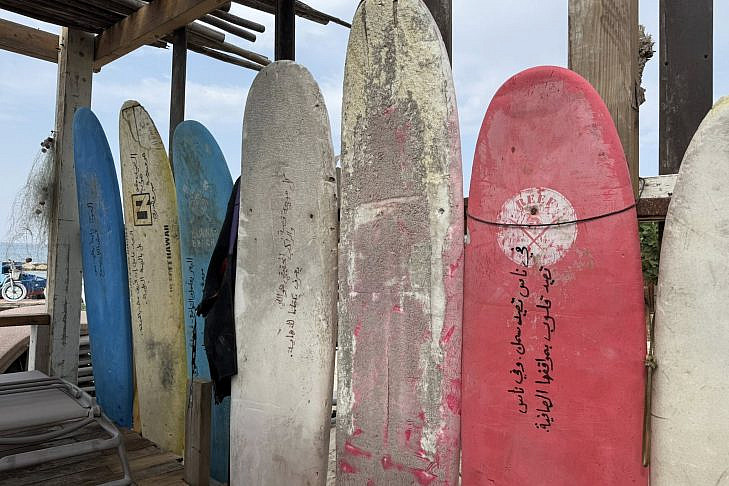
What I did not expect was a remarkable encounter with Hammame, a 47-year-old Arab woman who runs the Jisr as-Zarka “Surfing For Peace” company on the shores of the sea, at the end of a tiny fishing village a quarter mile from the main part of the city. Her passion for making change in Israel, one child at a time, one class at a time, one customer at a time, was palpable. We laughed when the Dror coordinator in Jisr related a story when she yelled at him, saying, “I am the beach!” and could, at the same time, completely picture it. You don’t mess with Hammame.
If only making change were so easy. She is fighting headwinds from every direction—Jewish schools that no longer want to bring their students to an Arab village, violence in Arab society between clans, schools that don’t want to open their doors to community programs—but she is fighting the good fight and then some. I’d challenge anyone to meet her and not be like, yeah, she gets it.
The drive from Jisr to the Bat Galim neighborhood in Haifa was a heritage tour for me. That southern approach to the city, through neighborhoods I’ve lived in and visited for the past quarter century, is always a warm and fuzzy experience, and it was then followed up with a remarkable school visit to a vocational high school run by Dror Israel.
Much like how vocational education and its project- and problem-based learning with a dose of entrepreneurship is making a comeback in Massachusetts, it was clear that for the Israeli students for whom the classic high school model is not working, these schools are an elegant and inspiring solution. We saw teens working on industrial engineering, new media, and oceanography, and heard about how the school blends technical learning with the regular curriculum and entrepreneurship. And…we met four therapy dogs, so it was elevated even more.
Skirting the port neighborhoods and sites of Iranian missile impacts, we crawled up through the Krayot to Acco, where we ate, went on an unsuccessful hunt for the fish statue (the theory was that they moved it when they built the new promenade on the harbor facing Haifa), and sadly observed a shuk where most of the stores were closed because tourism is down so much.
We followed up our touristy Acco time with a series of meetings with Dror educators who are immersed in trying to make change in a difficult environment. The lazy way to describe Acco (which I have been guilty of) is to say that it’s a mixed Arab and Jewish city. The nuanced way is to say that it’s a city where Arabs and Jews live, but the Jews are a mixture of recent olim from Russia, religious Jews who are hoping to make Acco more Jewish for a particular reason, and Dror educators and like-minded progressives who are trying to make Israeli society better…and one can imagine how it’s hard to get all of those groups to pull in the same direction. I appreciate the idealism, and I’m rooting for the betterment of society to win. Still, if you can’t get the Israeli and Arab kids from the youth movements to even take a picture together, then you get a feel for the challenge. And, of course, it’s more complicated than that.
We then entered the musical part of the chat with a concert from HaShayarah with the Israeli singalong classic “Sweet Home Ra’anana” winning the day, and then headed across the Galilee with a singalong of our own on the bus. Ruth Kaplan crashed down next to me and we decided to do a jukebox evening of classic Zionist and Israeli songs from, gently speaking, 1970-2000, and the hits kept coming—Sharm El Sheikh, Uf Gozal, Ani v’atah, Yihyeh Tov, Shir HaPalmach, HaRe’ut, and more. I know it brought us some joy, and even with my scratchy voice, I think a good time was had by all. But then again, in some universe it could have been perceived as annoying.
A 10:30 arrival at the Ayala Hotel at Ayelet Hashachar was highlighted by iced cappuccinos (or something) waiting for us when we got off the bus, but that was a hard pass for me, and I was asleep by midnight.
Day 6: On the periphery
Well, breakfast was gonna breakfast and I think we all over-ate and over-caffeinated, as I continued to fall in love with the coffee machines that whip up whatever you want in 45 seconds—espresso, double espresso (me), cappuccino, americano, you name it. I had plenty.
A cross-Galilee drive then led into a gentle drive up into the Golan Heights, where we watched the Hula Valley get more distant, drove past Druze villages and Israeli towns really leaning into the ski resort motif, beheld Nimrod’s castle from below and above, and made a gorgeous ascent into Majdal Shams, a 20,000-person Druze town on the Syrian border in the shadow of Mount Hermon.
This was the first time for me in Majdal Shams, and a tough one. As you may recall, in July of 2024 a Hezbollah rocket fell on a soccer field in the middle of town, killing 12 children. For the Druze of the Golan, who had been hedging their bets and by and large not taking Israeli citizenship (a complicated issue due to the fact that two generations ago they had been Syrian citizens), this was both a moment of incredible trauma and pain and also perhaps a tipping point. We spoke to the Dror leaders in town, felt and heard their pain, and saw the twisted metal on the fence, still not repaired, on the playground adjacent to the field. The wounds of this dark day will never be healed.
As the nation mourned with Majdal, a year later, the Druze on the Golan watched in horror as the Syrian Druze community was targeted by the Sunni Bedouin and perhaps the armed forces of the new Syrian regime in an escalating series of horrific attacks. In Sweida, the IDF took the extraordinary step of intervening directly to protect the Syrian Druze, and even bombed the defense ministry in Damascus to deliver a message: If no one else will step in to protect the Druze in Syria, we will. It was a seismic moment in the region.
One can debate the motivations of Israel’s actions (Political? Moral? Cynical? Self-serving?), but it’s clear that they have been a factor in the Golan Druze pivoting toward more participation in Israel society. Dror youth movement numbers are up. National Service participation is up. Israeli citizenship claims are dramatically up. This is a good thing.
Descending back to the Galilee, we visited Tel Hai to talk about Trumpeldor, ate lunch in Kiryat Shmona and learned about the impact of the war and displacement of more than 60,000 residents of the northern border region for over a year, and heard from a number of people about the rebuilding of a community very much on the periphery of Israel.
We volunteered in a nascent community garden where some of us planted kumquat trees while others (present company included) did more destructive things like ripping up bushes and removing dead trees, met with a group of 20-somethings working on reinvigorating communal activities, and had coffee with a Dror executive who left Tel Aviv after two decades with his wife and two kids and moved to Kiryat Shmona explicitly to help grow the community from 25,000 to 50,000 over the next decade.
Does that sound crazy?
Maybe.
Dror, and others, are trying to support life on the periphery—we met these pioneers in Sderot, in Acco, and in Kiryat Shmona. In Sderot and Acco, there is access to Tel Aviv and Haifa via train, but in the Upper Galilee, it is an hour to Karmi’el to get to the train or a movie theater and a half hour to Tzfat for a hospital. There’s not a lot of there, there, but there is a vision to make it so much more.
Listen, Tel Aviv was once sand dunes. As I sat there, listening to the vision, sipping Turkish coffee, and looking at the moon rising over the Hermon, I could begin to see it. In a parallel universe, I could even see myself giving it a shot. I hope it works out.
Our final night together began with a quick Maariv service to say kaddish, a not-in-a-hurry-at-all group dinner where we closed down the dining room, and a lazy gin and tonic on the outdoor patio, with the group not ready to say goodnight. Unfortunately/fortunately, I had a student on Zoom at 11:30 (4:30 Boston time), so I headed out first.
But the world was also not done with me, as the ripple effects of the ongoing government shutdown hit me 5,500 miles from home when my Newark-to-Boston flight was canceled. United, in an act of great benevolence, re-routed me home through, where else…Chicago.
You can’t make this stuff up.
Day 7: Heading home, leaving home
Breakfast was eaten, a d’var Torah was given in an attempt to say kaddish quickly (but the 10th minyan-attender left), “Happy birthday” in Arabic was sung to Gadir, our driver, and then we hit the road. Somehow I had two double espressos and a Turkish coffee all before 8:45. Was it a good idea? Unclear.
A morning stop at Kibbutz Eshbal, near Karmi’el, gave us insight into the kibbutz and its therapeutic horse stable and kennel, in addition to meeting some of the founders who are living out their Zionist dream on a hilltop near Sachnin. It was yet another encounter with a small group of people who have married their passions and Zionism with their work in bringing about positive change in their local community. Plus, dogs always elevate everything, and we met many.
A slow and meandering ride down toward Haifa bled into a trip down Route 6, and then a slow crawl into Tel Aviv for just-before-Shabbat traffic. I didn’t mind at all as it helped me get a lot of this piece written down. A farewell lunch in South Tel Aviv was filled with some earnest reflections on the trip, what we learned, and, of course, what we will be doing after this mission given all that we experienced.
I’ll have a lot more to say about that in the next post, but here’s a spoiler: It’s going to be hard. But all things worth doing are usually not easy.
I will say it was a remarkable group that pulled folks from all over and somehow it all made sense. Was I glad to come? You bet. Was I sad to leave? A little, but I know I’ll be back soon.
As we split up to either head home, head to friends’, or head somewhere else, I was fortunate that one of my fellow colleagues was also on the Chicago flight and had booked a hotel room for a few hours, so we killed a few hours in town, I went for run up and down the beach again, and got ready to leave.
The cab ride to the airport, which I shared with my trip-mate, was an instant classic. Our driver, Yosef, was a 60-year-old tank of a human who was the personal driver for a general during the First Lebanon War, lived in Miami, Toronto, Ghana, and Bucharest before marrying an Ethiopian-Israeli woman who came over on their first (and secret) aliyah, and he just let it fly. We talked about Bibi, Trump, the war, race relations, importing fake jeans to Canada, working security at Romanian casinos owned by Israelis, weekend trips to Moldova, Waffle House, the Steelers, and a whole lot more. A huge portion of this banter is not appropriate for this platform, but we had an absolute blast. I was quite sad when the ride ended.
A leisurely evening at the airport in the Dan Lounge (thank you again, Marc) set the table for what I hoped would be an easy flight home. We took off just after midnight, heading west, heading home but also leaving it.
Day 8: Chicago is not on the way to Boston
Never have I ever taken a flight that landed a full hour early, but somehow that happened. I slept, sort of, for little spurts of time, but then again it had to have been more than that because I actually didn’t really watch anything. I kind of watched part of “Skyfall,” but generally tried to rest. It must have been partially successful.
We hit the tarmac at O’Hare just after 4 a.m., I flew through customs, grabbed a Starbucks, and with a brain thinking it was 1 p.m. kept writing as I waited for the final part of the journey. After the overnight jaunt from Tel Aviv, the short 2-hour flight passed in the blink of an eye, and for the first time, one of my sons actually picked me up at the airport. Thanks, handsome.
So, here I am, there and back again yet again, and ready to go back already…and ready to help dream about, and work toward, Israel’s future and a Dror Israel vision for Zionism that is really hard to argue with.
This post has been contributed by a third party. The opinions, facts and any media content are presented solely by the author, and JewishBoston assumes no responsibility for them. Want to add your voice to the conversation? Publish your own post here. MORE