





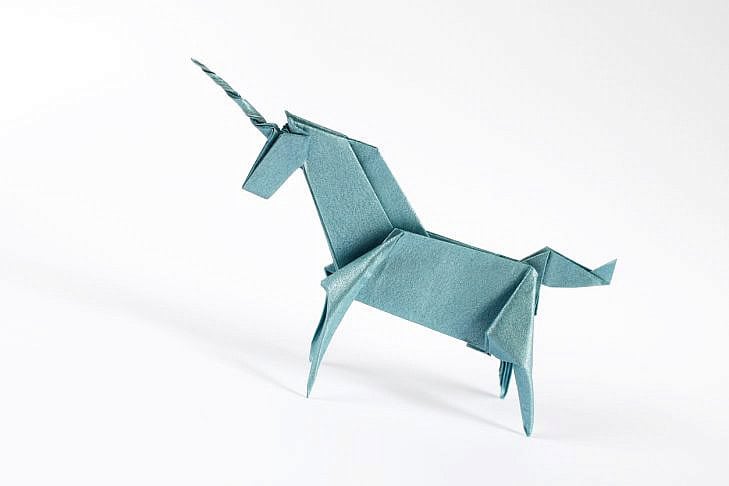
At some point, we all learned about the Garden of Eden. Adam and Eve, the serpent, some trees, disobedience, and so on. And while many of us are also familiar with the usual “such-and-such was created on day x, God rested on the seventh day, and then we were kicked for eating from the Tree of Knowledge,” there’s a decent chance none of us had considered the idea that there may have been a unicorn roaming freely on the grounds. Luckily, tradition has us covered there, and afterwards. Off we go.
The idea of unicorns in Judaism pops up in rabbinic literature under names like the keresh, the tachash, or Adam’s one-horned ox. Our sources paint a picture of a creature that was a part of the Jewish experience from the dawn of man.
An early midrash, as they tend to do, found a problem in the Torah. Genesis 3:21 says, “The Lord God made garments of skin for Adam and his wife and clothed them,” which led the commentators on a quest to identify the kind of animal that Adam sacrificed to make those skins. Scholars somehow made a logical leap from this verse and declared they had found a clue in Psalms that would give us the answer: the skins God used to clothe Adam and Eve may have come from the very animal that first stood in Eden…the unicorn.
The Jewish imagination claimed that the animal Adam sacrificed was a unique “one-horned ox,” citing Psalm 69:32, which mentions a horned (makrin) ox. The word can be read as both singular and plural, but where’s the fun in a two-horned ox? By making it singular, we have a unicorn. This links neatly to the keresh of halakhic discussion and later on, the tachash of the Tabernacle, a singular, extraordinary creature that could be offered as a sacrifice without wiping out an entire species. While it’s not listed in Pirkei Avot’s collection of magical objects created just before Creation ceased, perhaps it should have been.
The Talmud endorses this interpretation in a surprisingly direct fashion. In Chullin 59b, the sages are reviewing the telltale signs of kosher animals (cloven hooves and horns) when we get a shocking one-liner from Rabbi Dosa: “With regard to the animal called a keresh, even though it has only one horn, its fat is permitted.” To this sage, and by extension to all of the sages, the unicorn (keresh) was real enough to be listed in halakhic debate as a kosher wild animal.
Another passage in Shabbat 28b talks about the skin of the animal called tachash that Moses used to cover the Tabernacle. Generations of bar and bat mitzvah students who had to read from Terumah have wondered about this word, which translators and commentators have called a ram, a dolphin, or even an antelope. In the Talmud, Rabbi Meir describes it as “a creature unto itself,” with “a single horn on its forehead.” Whatever it was, it appeared in the Torah just in time for the building of the Tabernacle and then vanished from the world and the lexicon.
Centuries later, none other than Maimonides weighed in. In Mishneh Torah, Forbidden Foods 1:12, he writes that the keresh is considered a wild animal “even though it has only one horn.” For the Rambam, the existence of the unicorn wasn’t a fairy tale but fact. Later commentators sometimes suggested the unicorn was an oryx or antelope, while others saw the tachash as a dolphin or ram. What mattered, though, was that Jewish tradition recognized such a creature as part of creation. There is certainly a chance that an antelope glimpsed in profile, a dolphin swimming in the Nile, or a desert ram missing a horn could have been construed as a unicorn, but that would ruin this party. For the unicorn-seekers, the boundaries between zoology and myth weren’t rigid.
So, yes, in Jewish tradition, a unicorn grazed in the Garden of Eden. Was it sacrificed by Adam? Who knows. A few thousand years later it returned briefly in Moses’ time to adorn the Mishkan, then vanished again. Perhaps the point is that the unicorn shows up only at the most pivotal moments, like when humanity first clothed itself and when Israel first built a dwelling for God. Then it fades away, reminding us that glimpses of legends, or perfection, are fleeting but unforgettable.
Keep your eyes open.
This post has been contributed by a third party. The opinions, facts and any media content are presented solely by the author, and JewishBoston assumes no responsibility for them. Want to add your voice to the conversation? Publish your own post here. MORE