





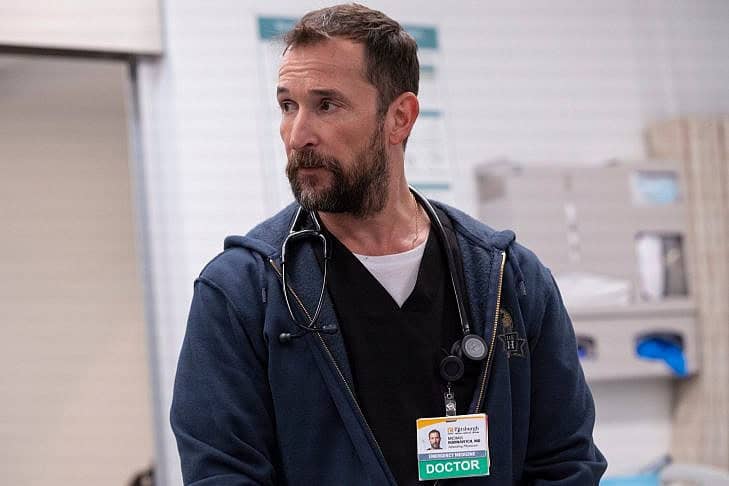
Recently, I started watching high-pressure medical drama “The Pitt.” This might be an odd choice for someone with a well-documented anxiety disorder, but I actually think it’s perfect escapist fare: The action is intense (it takes place on a trauma unit, after all); the pacing is brisk (I can’t even scroll for fear I’ll miss something) and Noah Wylie is still smoldering after all these years since his breakout role on “ER.”
Wylie stars as Dr. Michael “Robby” Robinavitch, the senior attending physician of a perpetually swamped, chaotic and sometimes dysfunctional emergency department, colloquially known as “the pit” by battle-tested doctors due to its chaos. (My friends who are physicians swear that this series is incredibly true-to-life; they call their emergency rooms “pits,” too. It’s sort of a term of endearment.)

Workplace dramas are always interesting; you typically only get a tidbit of a character’s personal life. Here, any glimpse at a private life is nearly impossible, since each episode is structured as an hour in the life of the hospital. We get slow-burn reveals, like the pregnancy struggles of Dr. Heather Collins (Tracy Ifeachor) or the childhood trauma of Dr. Trinity Santos (Isa Briones). That drip-drip-drip (no pun intended) pacing keeps viewers hooked. Who are any of us, really, when we get into work? What sides do we choose to reveal? What prior wounds leak out, and why?
Robinavitch’s Judaism isn’t overt; the clearest sign we get is during Season 1, Episode 14, when he breaks down and cracks, curls up and recites the Shema while clutching his Star of David necklace. It’s raw, primal. Real. The prayer asks us to hear God when we can’t see God. And it’s hard to see God among mass bloodshed.

Without giving away too many spoilers, Robinavitch breaks down because, after a relentlessly frantic day on the job, the ER receives an onslaught of mass shooting victims — and he’s close to one of the casualties. The day is also significant because the shift marks the five-year death date of Dr. Adamson, his mentor, whom he couldn’t save during COVID. The loss haunts him. He doesn’t normally work on this day. But, thankfully, today he does.
It’s ironic that medical providers, forced to deal with people during their most vulnerable and human moments, so often keep up a shield themselves. Toughness is a virtue; resilience means restraint. It’s a survival skill amid death.

But when he’s asked, plaintively, “Why couldn’t you save her?” he has no answers. Only tears. Only the choking response that he saved countless lives, but remembers only the names of those who died. Cut to black. We next see him shuddering and praying against an animal motif in the ER — a jarring vision of hospital-brand joy mixed with intense horror.
What I like about “The Pitt” is that it doesn’t flaunt Robinavitch’s Judaism like a quirky personality feature (hello, “Nobody Wants This”); it’s core to his identity in times of trouble and aimlessness and fear. But it isn’t a prop. He just puts his necklace away, strung beneath his blood-soaked gown, and returns to more chaos in an often godless place.
“The Pitt” is currently streaming on HBO Max.