



Synagogues, churches, and mosques are places of worship, connection, and celebration. Amid a climate of rising hate, they have also increasingly become frequent targets for those seeking to cause destruction and sow fear.
According to the ADL, Jewish institutions including synagogues were targeted with acts of vandalism, arson, or bomb threats more than 1,700 times in 2024 alone, a sharp rise from previous periods. Churches and mosques have seen fewer attacks but a corresponding rise during the same period.
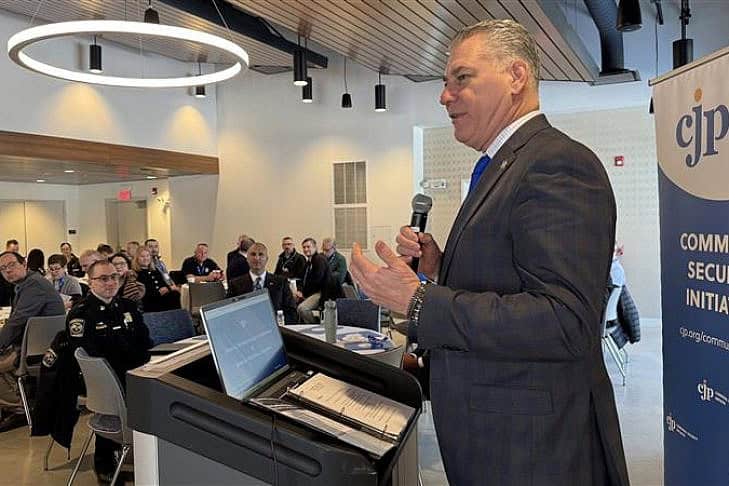
Amid this threat environment, Combined Jewish Philanthropies’ Communal Security Initiative (CSI) convened an Interfaith Security Summit in February for information sharing, partnership building, and frank conversation about keeping houses of worship safe.
“Community partnerships are crucial to improving security,” said Jeremy Yamin, vice president of security and operations at CJP. “Bringing together law enforcement, security experts, and leaders of houses of worship improves communication, facilitates sharing best practices, and serve as powerful tools to recognize, manage, and mitigate threats.”
Middlesex County Sheriff Peter Koutoujian, one of the keynote speakers, said that in a moment of heightened anxiety and uncertainty across many communities, and the Jewish community in particular, trust between law enforcement and the public is the cornerstone of security.
Representatives from the Ashland Police Department echoed that spirit, emphasizing that law enforcement seeks to maintain close partnerships with faith communities.
Arthur Maserjian, senior director of CJP’s Center for Combating Antisemitism (CCA), noted that partnerships between faith communities and law enforcement are one of the key recommendations made by a special legislative commission’s work last year as part of a plan to address antisemitism in Massachusetts.
“The commission reinforced what many of you already practice. Partnership is essential to prevention and response,” he said. “CCA helped inform this work and we’re now focused on implementation and coordination.”
Know Before You Click
In addition to relationship-building, the day also featured security guidance on situational awareness, cybersecurity, and protecting houses of worship from the threat of arson.
Lino Covarrubias, CEO of Jewish Family Service of Metrowest, shared that CSI’s cybersecurity program provided free online training for staff. The cybersecurity awareness training platform transformed his organization’s vulnerability to phishing attacks. Before the training, 50% of staff were clicking on phishing test emails; after, that number dropped to 3%. It was a striking illustration of how much targeted training can move the needle and a practical takeaway for every institution in the room.
Preventing Crimes Against Houses of Worship
Perhaps the most sobering session was led by Matt Harnett, special agent with the Bureau of Alcohol, Tobacco, Firearms and Explosives and certified arson investigator, who provided critical information on arson prevention. In the past two years alone, nine houses of worship in New England have experienced fires — some arson, some accidental — including a devastating series in Providence in 2024. In one case, the same juvenile set fires on consecutive Sundays.
Harnett outlined several factors that make houses of worship targets for arsonists: they are frequently unoccupied, perceived as inviting, operate on predictable schedules, and occupants often lack situational awareness. Motivations range from hate and extremism to crime concealment, vandalism, and opportunity.
In addition to the basics — keeping doors and windows locked and limiting key access to critical staff only — Harnett’s security recommendations covered building materials, landscaping, parking arrangements, roof access, lighting, and cameras.
For Jewish institutions and interfaith organizations seeking security support, CSI offers free security and medical training, cybersecurity assessments, physical security consultations, and much more. For more information, visit the site or email us.