





This year’s Boston Jewish Film Festival will again showcase films from Latin America. Two of them in particular—a documentary and a semi-autobiographical movie—tell complicated stories in direct, compelling styles. Mi Vida con Carlos is Germán Berger de Herz’s homage to his father Carlos who was murdered by Augusto Pinochet’s henchmen in 1973. Germán was a year old when his father, an activist and human rights lawyer, was jailed in the north of Chilé and never heard from again.
 The son delves into his father’s short life through pictures, old 8mm films and detailed interviews with his mother Carmen Hertz and two uncles. Carmen Hertz is also a human rights lawyer—a woman who has been at the forefront of fighting the brutalities of the Pinochet regime. “Justice is the only way to real peace,” she tells her son in the film.
Carlos Berger’s parents, Eastern European immigrants, settled in Chilé on the cusp of the Second World War. Like the children of many immigrant Jews, the Berger sons were invested in the life and politics of their country. Carlos’ mother, Dora Guralnick de Berger inspired her oldest son to pursue social service, to repair the world. Hers was a tikkun olam that had its roots in socialism.
After Carlos’ murder a fragile silence, “like a thin sheet of ice,” coats the family. No one speaks openly about Carlos yet he remains a strong presence. Carmen and Germán eventually flee Chilé, but return despite the ongoing Pinochet dictatorship. They finally leave Chilé in 1987 when they find their young maid with her throat slit—a shocking message that the family was in grave danger.
The genius of Berger’s documentary, shot in 35mm and interspersed with archival footage, is that at its core it’s a son’s love letter to his phantasmagoric father. Te Extraño is director Fabián Hofman’s thinly veiled autobiography of his life during Argentina’s military dictatorship in the 1970s. The movie focuses on Javier, a high school student whose older charismatic brother Adrian is “disappeared”—an unsettling euphemism that stands in for the foregone conclusion that he was murdered.
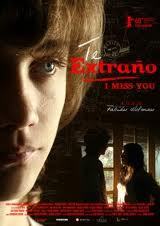 In a panic, Javier’s parents send him to his aunt and uncle in Mexico where he coincidently meets up with a couple of Adrian’s cohorts. As in Mi Vida con Carlos, there is the same sort of fragile silence—that thin sheet of ice—coating Adrian’s disappearance. Javier eventually reunites with his parents and against their wishes returns to Buenos Aires.
In the last scene of Mi Vida Con Carlos, Germán Berger de Hertz shows how disorienting it is to live with a ghost who cannot be buried. Germán and his uncles travel to northern Chilé to mourn Carlos at his grave. But they can only guess where their father and brother is buried. In that last scene the son assures the father that he has the love of his wife and children. Yet his shadow life with Carlos is what has made him a man. Clearly, Javier’s life will also be defined by Adrian’s disappearance, and by the end of the film it has catapulted him into manhood.
Both of these remarkable yet understated films depict a horrific limbo in which the disappeared are neither dead nor alive. This limbo underpins the bold fact that in the end the political is inevitably personal.
This post has been contributed by a third party. The opinions, facts and any media content are presented solely by the author, and JewishBoston assumes no responsibility for them. Want to add your voice to the conversation? Publish your own post here. MORE