





Who doesn’t remember the excitement and energy of a new school year? The buzz of possibility, the nervous energy about classes, classmates, and that vague notion of something called “the future.”
For Jewish college students across the region, that excitement still exists, but in recent years, it’s been mixed with apprehension and anxiety.
As our community approaches the second anniversary of Oct. 7, strengthening relationships with K–12 schools and university leaders across Greater Boston has never felt more important. Tens of thousands of Jewish students have returned to classrooms this month, and Combined Jewish Philanthropies, alongside our partners, is working with educators and campus partners to create space for dialogue, understanding, and safety.
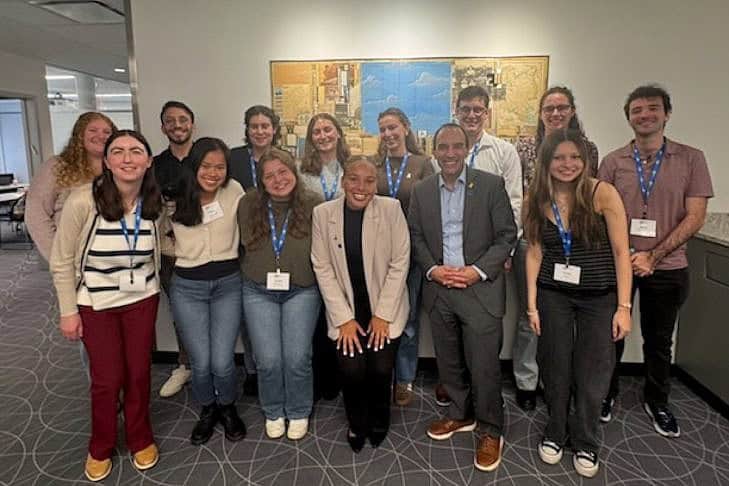
To help ground our work, I recently met with student leaders from eight Boston-area university campuses to reflect on the year ahead. I was mostly there to listen, ask questions, and let students know we are here to support them. What I learned gave me strength and hope.
The young people we met with didn’t shy away from voicing their concerns, but they also helped remind me that vibrant, inclusive, authentic Jewish communities abound on our local campuses and are deeply engaged in meaningful, constructive work.
Students spoke about collaborating with other organizations on campus and observed that there is less general animosity toward Jewish institutions and Hillels than in years past. One student leader reminded me that half the undergraduate student body is new since Oct. 7. The student leaders described energy, momentum, and joy, all part of increased engagement they are seeing on their campuses. Their descriptions mirror the higher levels of engagement we are seeing in Jewish life of American Jews since Oct. 7, 2023.
Of course, none of this is without significant challenges and areas of concern. Students expressed that they and their peers continue to experience social marginalization and, in some cases, explicit discrimination, mostly related to Israel and Zionism. They shared real concerns about antisemitism and also concerns of the weaponization of antisemitism to attack their universities; both of which, they fear, go badly for Jewish students. Students at our roundtable said they still often feel tension and misunderstanding from others on campus and feel caught up in a larger culture war, with administrations often slow to respond or lacking in sustained action.
These student leaders appreciate knowing that our community has their backs, and they appreciate our support. They need practical tools to strengthen Jewish life, confront hatred of Jewish people and Israel, and engage constructively with other campus groups, with whom they want to strengthen relationships.
We brainstormed potential new ways for CJP to support on-campus initiatives, including expanding leadership fellowships with Hillels and even local high schools as a way of scaling up participation. We also talked about connecting these student leaders more closely with CJP’s Center for Combating Antisemitism (CCA) for mentorship, resources, and community relations tools. Much of this work is already being done by CCA as part of our Campus Resiliency Grants focused on funding campus-based projects to advance dialogue and allyship, education and advocacy, and joyful Jewish life.
Most of all, just bringing these student leaders together reminded me of why we do what we do. After the meeting, Chloe, a Brandeis University student, shared, “Being in the room with other students my age made me feel heard and seen and realize that every student struggles with antisemitism. Having a community [makes me] realize that we’re all in this together and we all must not quit despite there being moments that may involve fear and anxiety.”
Another student, Rachel, an undergraduate at Harvard University, asked me to make sure our community knows that, “Jewish life is still flourishing on campuses, even though we’re facing problems since Oct. 7. I think it’s the start of a new era.”
I admire these young leaders’ resilience and strength. They combine realism and positivity, and they are committed to building stronger, more connected Jewish communities on their campuses and for their generation.