





I was shockingly not shocked by the massacre on Bondi Beach. And that realization hit me harder than the news itself. I found myself wondering: Has baseless hate against us become so normalized that nothing surprises me anymore? If so, that’s not just a Jewish tragedy — it’s a societal one.
In the hours after the attack, a thoughtful colleague reached out with “thinking of you” and “my prayers are with you.” I genuinely appreciated his kindness. But I also found myself saying something I didn’t expect to articulate out loud: “Thank you…and we need more than thoughts and prayers right now. We need your help. We need you to stand with us.”
He paused and asked, “What does standing with you look like?”
I couldn’t answer him.
I have experienced antisemitism throughout my whole life — from the subtle (“Your people are so good with money.” “Does keeping kosher make sense anymore?”) to the blatant (boys sitting behind us at a baseball game taunting my older brother for the kippah on his head, a colleague loudly ranting about the Israel-Palestinian conflict right near me when he saw my husband’s kippah on his head).
But despite knowing what antisemitism looks like, I didn’t have an immediate answer to my colleague’s question: What does standing with us and fighting for us look like?
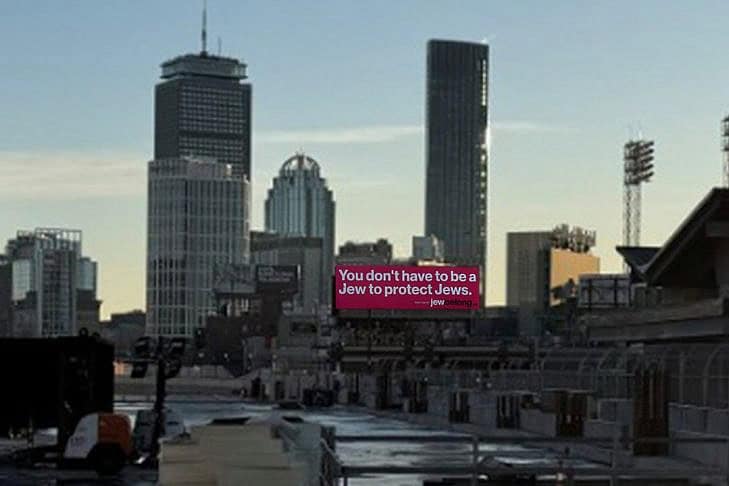
Then I saw a billboard on my walk to work (see pink sign above). It motivated me to try and come up with an answer. And since it was only after mile 1.5 of my 4-mile walk, I had time to think about it. Here’s what I’ve come up with so far:
Real Allyship Is About Trying to Make Change
A former colleague recently hosted a powerful forum on antisemitism at the HBS Club of New York. It was thoughtful, challenging, and brave. I thanked her afterward and said, a bit awkwardly, “I didn’t realize you were Jewish.” She simply replied: “I’m not.”
That moment floored me. A non-Jewish leader stepping up, using her voice and influence to address antisemitism, not because it affects her personally, but because she refuses to tolerate hate — that’s what support looks like. That’s what standing up looks like.
Billings, Montana: A Model I Wish the World Would Follow
In 1993, a brick was thrown through the window of a Jewish family in Billings, Montana, because they had a menorah displayed. I still get chills remembering what happened next: the Billings Gazette printed a full-page menorah, and thousands of people — most of them not Jewish — taped it to their windows. Their message was unmistakable: “If you threaten one Jewish family, you threaten us all.”
That story still brings me to tears. It is exactly the kind of collective courage we need today.
Understand Our History
Even though I’ve been Jewish my whole life, I didn’t understand the full depth and architecture of antisemitism until I dug into it more in the past two-plus years.
It’s not just prejudice; it’s a centuries-old system of myths, tropes, and false narratives that keep reinventing themselves. It goes on overdrive anytime a majority group needs a minority to be a scapegoat.
Sarah Hurwitz’s book “As A Jew: Reclaiming Our Story from Those Who Blame, Shame, and Try to Erase Us” really helped me understand the history of antisemitism. I recommend it, because anyone who wants to fight antisemitism needs to understand where it comes from and how it mutates.
Ask the Disrupting Questions, Nicely
When you hear something that feels like it’s drifting toward antisemitism — or repeating an antisemitic trope — you don’t need a dissertation. You only need a few simple, gently probing questions: “What do you mean by that?” “Why do you think that?” “Have you considered this perspective?”
Curiosity can interrupt bias in a way that confrontation sometimes can’t. It asks people to examine their assumptions — often for the first time.
See the Double Standard Jews Live With Every Day
One of the most confusing parts of being Jewish today is the global assumption that Jews everywhere are personally responsible for every single action of the Israeli government. Being a Zionist does not mean I fully support every decision of the Israeli government.
Let me say it plainly: There is no other population on Earth subjected to this expectation. Even the most oppressive governments: Not Russians for Putin. Not Iranians for the regime in Tehran. Not Chinese people for Beijing.
Should all Americans be responsible for every action of their current elected officials and military?
Yet Jews — including those who don’t live in Israel, don’t vote in Israel, and don’t know enough to agree or disagree with every Israeli policy — are held to a different standard entirely. As a Jew, this has become one of the clearest markers of how misunderstood and uniquely targeted our community remains.
It is (way past) time to ask for help
Jews have spent centuries trying to educate, explain, integrate, advocate, and fight hate on our own. We’ve tried to be resilient, strong, stoic — because we had to be. The past two-plus years has generated so much fact-based hate-fighting content that circulates among the Jewish community only, wasted.
Bondi Beach feels like the breaking point. I’m tired. My community is tired. And saying that out loud is not a weakness, it’s truth. We cannot carry this alone anymore. We need help. We need allies. We need people who aren’t Jewish to stand up, speak up, and push back.
And Then There’s Ahmed
And in the middle of all this fear, pain, and exhaustion, a moment of profound humanity — Ahmed al Ahmed, a Syrian-Australian Muslim man, tackled and disarmed one of the gunmen at Bondi Beach. A Muslim man saving Jewish lives.
That act moved me beyond words. It was a reminder that hate is not destiny — and that our fates are intertwined far more than the world wants us to believe. He didn’t act because we are the same faith. He acted because we are the same humanity.
This Is What Standing Up Looks Like
For me, as a Jew living through this moment, standing up looks like:
- Learning the history so you can recognize antisemitism when it shows up — subtly or loudly.
- Using your platforms — big or small — to speak out.
- Asking thoughtful questions when bias creeps into conversation.
- Rejecting the unfair standard that holds Jews accountable for a government many of us have no role in.
- Showing up, publicly and privately, with conviction, not just sympathy.
If you’re asking, “What can I do?” — start here. Start imperfectly. Start humbly. Start with heart.
But please, don’t sit it out.
This post has been contributed by a third party. The opinions, facts and any media content are presented solely by the author, and JewishBoston assumes no responsibility for them. Want to add your voice to the conversation? Publish your own post here. MORE