





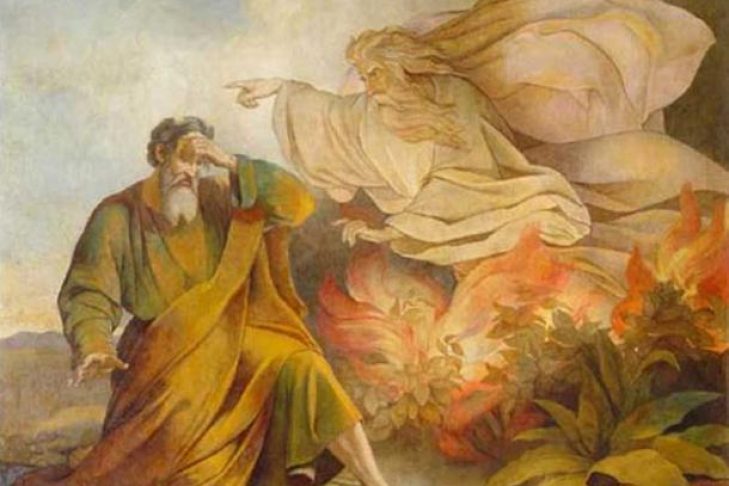
The Torah has a few peak moments—we just read one of them.
While Moses is tending his sheep in Midian, he beholds a great and wondrous sight—a burning bush, fully aflame, yet not being consumed by the fire. Stunned, he turns aside to take a look, and, lo and behold, God speaks to him from the conflagration.
God speaks to Moses and offers four promises of redemption: I will bring you out, I will deliver you, I will redeem you, and I will take you to be My people. These are not abstract words; they are lifelines spoken into a world of suffering. And, most importantly, those promises are fulfilled.
But what happens when the fire shifts from metaphor to reality, when the world itself seems ablaze with hatred, and when the voices that should cry out instead fall silent?
The bush burns today with the relentless drumbeat of antisemitism. Just last week, we saw an arson attack on a Mississippi synagogue, a rock thrown at a Jewish school bus in New Jersey, and pro-Hamas protestors on the streets of New York. To add fuel to the fire, we have the ongoing scandal in the UK about Israeli fans being banned from a soccer match, Mamdani’s absurd threat to arrest Netanyahu if he visits New York City, and a grab-bag of other goodies.
Meanwhile, in the real world, entire communities are living under siege, and yet the outrage that should be deafening is barely a whisper. When women in Iran risk their lives for freedom, the world shrugs. When Hamas slaughters innocents, the hashtags dry up. When Christians are massacred in Africa, the news barely registers. But when it comes to Gaza, the hashtags flow like wine at The Red Wedding, and celebrities line up to perform their righteousness for the cameras.
It’s a brave new world of curated morality, where outrage is branded, and selective silence is a strategy; nothing’s easier than blaming the Jews, and nothing’s harder than finding somewhere else to direct your performative outrage. After all, it’s far easier to repost a slogan than to wrestle with complexity, way easier to condemn Israel than to confront Iran, and much more convenient to follow the algorithms than to think for yourself. In fact, why think at all? It only took a few minutes for Israel/The Jews to be blamed for the Maduro operation as well.
Of course, this is not new. The fire has always been there. Egypt enslaved us for centuries. Babylon burned our Temple. Rome scattered us to the winds. Europe expelled us, ghettoized us, and slaughtered us. Pogroms swept through Russia like storms. The Holocaust reduced 6 million lives to embers. And after all that, after every inferno, we were told and expected to disappear quietly, to accept our fate, to vanish into history.
And yet we endure. Not because the world saves us—that never happens— but because we still believe in those promises spoken from the fire. Because we know that even when the world burns, hope can still rise from the ashes.
Our ashes.
When Moses hesitates at the bush, afraid, uncertain, convinced that he is not enough to lead the Hebrews, God answers with the simplest, most powerful truth: I will be with you. That is the promise that has carried us through every exile, pogrom, genocide, blood libel, and massacre since the dawn of our time. Not that the fire will vanish, but that we will not face it alone. Not that the world will love us, but that we will not be consumed.
So, let the hashtags trend. Let the outrage be staged. We’ll keep doing what we’ve always done—survive.
The bush still burns. And so do we.
This post has been contributed by a third party. The opinions, facts and any media content are presented solely by the author, and JewishBoston assumes no responsibility for them. Want to add your voice to the conversation? Publish your own post here. MORE