





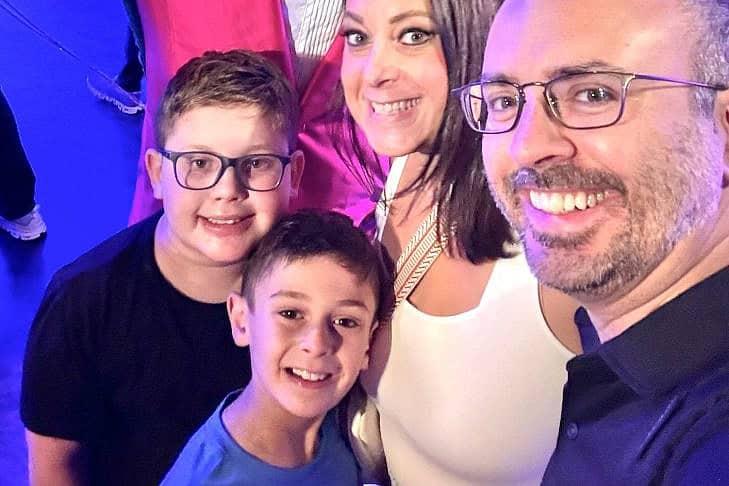
Jamie Perelman’s son, Simon, started at The Rashi School in 2019. When the Needham mom got a call that Simon needed potential attention from a speech therapist, she was relieved that Gateways stepped in to help. Gateways offers high-quality special education services and support to enable kids to succeed in Jewish educational settings. Simon has ADHD and anxiety; now a sixth grader, he’s thriving. Perelman shared what the Gateways process was like for her family and what she’d like other families who might be wondering “Is my child OK?” to know.
How did your family become involved with Gateways?
When Simon was in first grade, his teacher alerted me that there might be something going on: A speech therapist from Gateways would visit lower-school classrooms at Rashi and observe once or twice a week. The speech therapist was so helpful for me navigating the whole process. I didn’t know anything about IEPs! This was my initial introduction to Gateways, which became our guiding light. They stepped up to give me all the information that I could possibly need. I sit on the executive committee at Gateways now, and it’s because I say: “Gateways saved our family.”
Could you share a bit about Simon’s diagnosis?
He has ADHD and anxiety. The combination of ADHD and anxiety is a difficult one, because ADHD makes you a little bit dysregulated — a lot bit dysregulated. The anxiety then makes you feel badly that you are dysregulated. It’s a bad cycle. Our Gateways speech therapist at school deals with social interactions. They were able to form a social group for him and a couple other kids, which was so helpful during second, third and fourth grade — to interact with other kids who also had difficulty in social settings. Writing is not his favorite thing, either, so therapists are also able to work with him on his fine motor skills.
What’s the experience of having a child “flagged” like for a parent? Did you suspect anything in advance?
We had no idea. Simon is extremely intelligent. This was the first time I had ever heard from any teacher that there was anything going on. It was really surprising; it was really scary. The school picked up on his emotional dysregulation. He was able to keep up academically, but socially, it was hard for him. Gateways supported him with executive functioning skills. They would help him organize his locker and his desk and work with him so his teachers were able to teach to the whole classroom, while the Gateways staff was able to navigate those other things.
Parents can be so overwhelmed by the individualized education program (IEP) process. I know I am! Were Simon’s services covered by an IEP, or were his services more informal?
At first, we were paying out of pocket. I was OK with it. I was just glad that there was somebody in the school who was able to work with him and work with the teachers when I couldn’t be there, to offer that help and guidance. I believe there’s a discounted rate for day schools. Working together as a team, we did eventually get an IEP done, and then we were able to get the services covered under the IEP, including speech and occupational therapy. With the IEP, he received services twice a week, two different days for 30 minutes, pullouts during non-academic blocks. He also had a “Lunch Bunch.” They would have lunch together, and they would play games.
How did Simon respond to his support?
He loved his teachers. Simon especially loves adults; he’s basically like a tiny grown-up. He’s not so tiny anymore, but he likes talking to grown-ups and has very adult conversations. It was a treat that he would get these one-on-one or two-on-one moments with someone who was working with him and was really interested in him.
What about you, as a mom? How did the support feel?
It was a lifesaver. I still had to be in touch with the teachers. I still had to navigate and integrate all the things that he was working on with the specialist into the classroom. That’s where I had to step in. But the Gateways specialists were able to give me one-on-one feedback.
Specifically, in third grade, Simon’s occupational therapist said we might want to look into dictation for writing or use of the computer. They don’t do this generally, because they want students to learn how to actually write and be able to monitor their handwriting and all that. But for Simon, it was so difficult. In order to complete tasks, it became a lot easier if he was able to do it digitally, so they were able to navigate that with me. For example, he had a reading journal, which he was able to keep on Google Classroom. He would work on that with either his teachers or the OT or me, and we all had access to it. It was a really useful tool.
Having two kids, I see the difference. When my younger son, Charlie, was in third grade and didn’t want to write, I reached out to the teachers. They said: “He’s fine. He can write. He just needs to push through it.” As opposed to Simon, who really needed access to dictating. It was really valuable.
What would you say to another family who might just be starting the special education process?
The first step is to understand that, if the teacher is reaching out to you, it doesn’t mean that there’s something wrong with your kid. Take it as a blessing that’s been brought to you, and utilize the services that are available in your school. No matter what you think about the IEP process, go get your IEP, because it’s how you get your services covered. Gateways is really great about helping navigate access to the services for those who might not be able to afford them too. Via Gateways, there are a lot of kids who are able to attend Jewish day school because Gateways therapists are in the school, helping to navigate the system.
Don’t be afraid. My way of advocating for my child and for others is to be kind of loud about it — meaning, there’s no shame in having any of these diagnoses. It’s your child’s superpower. Just because they look at the world or learn about things differently than others doesn’t mean they can’t do it in the same setting as other kids.
Embrace it — we’re very open with Simon about everything, because I think it’s a really important thing to understand: You are going to stumble and you are going to fall and you are going to have bad days.
Be open. Don’t stay quiet. Talk to people. At Rashi, the new head of school and I were able to work together to create a new program with our dean of support services offering access for parents to talk to each other, to work with teachers in partnership. I think that’s the biggest thing: You’re not alone. Everybody wants the best for your kid. It can be really difficult to feel like you have a place in a community, so working as a team with the teachers and staff is really important.