




For many people today, Yiddish is thought of as a language in decline. We happily sprinkle “oy” and “schmutz” into everyday speech, usually without pausing to consider the rich cultural world from which they emerged. Long before Yiddish was framed as something to be “saved,” it was a living, thriving language at the center of Jewish life across Eastern Europe. It was the language of daily conversation, humor and argument, journalism, poetry, theater, and, yes, popular fiction.
At its height in the late 19th and early 20th centuries, Yiddish supported a vast cultural ecosystem. Newspapers reached hundreds of thousands of readers. Theater stars were international celebrities. Writers experimented boldly with genre, style, and modern ideas. Among these works were mystery novels that would feel surprisingly familiar to contemporary readers, including a series featuring a sharp-witted, observant detective often described as the Yiddish answer to Sherlock Holmes.
These books were page-turners in their time: smart, suspenseful, and deeply rooted in the textures of Jewish life. They reflected bustling cities, sharp social commentary, and communities negotiating modernity, tradition, poverty, and aspiration—all in Yiddish. Today, many of these works live quietly in archives, preserved thanks to institutions such as the Yiddish Book Center, which houses one of the most significant collections of Yiddish literature in the world.
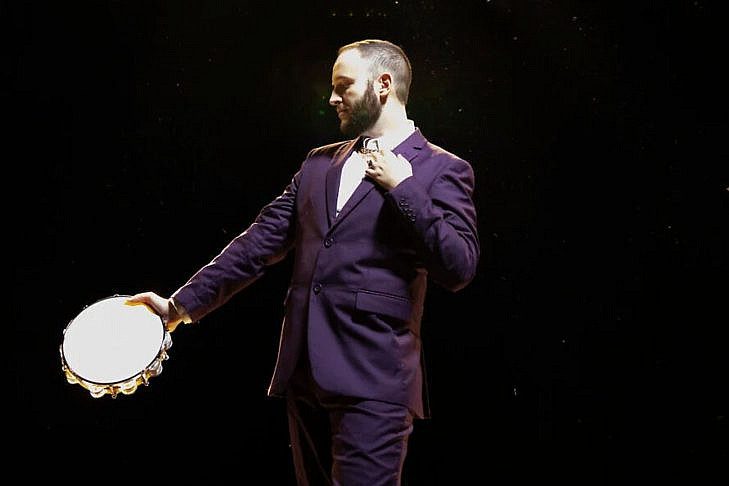
Now, one of these long-overlooked stories is finding new life. For the first time, “Max Spitzkopf,” one of the detective tales, has been translated into English by Mikhl Yashinsky. Yashinsky is a translator and actor who has not only rendered the text for new readers but also reimagined it for the stage.

For Yashinsky, Yiddish texts are not museum pieces. His translations preserve their humor, pacing, and emotional texture, helping modern audiences experience them as the gripping popular fiction they once were. As an actor and performer, he brings these stories off the page and into the room, drawing on Yiddish theatrical traditions where storytelling, character, and music often blend seamlessly.
Yashinsky speaks excitedly about Max Spitzkopf, a fictional detective who appeared in a popular series of Yiddish mystery stories written in the early 20th century by Jonas Kreppel. Often dubbed the “Yiddish Sherlock Holmes,” Spitzkopf was a sharp-minded investigator whose cases unfolded within the distinctly Jewish worlds of central and Eastern Europe.
Unlike Arthur Conan Doyle’s famously aloof detective, Spitzkopf operated within the social fabric of Jewish life. His investigations took him through crowded streets, cafés, boarding houses, and immigrant neighborhoods, where cultural nuance, class tensions, and communal dynamics mattered as much as clues. The stories blended classic detective tropes—keen observation, clever deduction, and suspense—with humor, social commentary, and an intimate familiarity with Yiddish-speaking society.
For decades, these stories remained largely inaccessible to non-Yiddish readers. Their revival today offers a rare glimpse into a genre of Jewish popular culture that once flourished—and reminds us that Yiddish storytelling was not only profound and poetic, but also clever, playful, and irresistibly fun. Now, in collaboration with musician Abigail Reisman and her trio, Yashinsky has transformed the text into a theatrical piece: a one-person show with live music that captures the energy of Yiddish storytelling. Premiering in Boston at the intimate and atmospheric Vilna Shul, the performance weaves together narration, character, and music to evoke the world from which the story emerged. What makes this project especially compelling is that it refuses to treat Yiddish culture as a relic. Instead, it presents it as it once was: playful, complex, urban, and very much alive. The piece is funny and moving, entertaining and thoughtful—a snapshot of a moment when Yiddish was not endangered, but everywhere. For audiences unfamiliar with Yiddish, this performance offers a welcoming entry point. It invites viewers to see Yiddish not as a “lost” language, but as one that profoundly shaped modern Jewish culture—and still has stories worth telling today. Whether you are a devoted Yiddishist or entirely new to the language and its culture, this new performance promises to surprise and delight. Join us at The Vilna for “Meet Max Spitzkopf: The Yiddish Sherlock Holmes” on Thursday, Jan. 29, at 7 p.m. Get tickets.
This post has been contributed by a third party. The opinions, facts and any media content are presented solely by the author, and JewishBoston assumes no responsibility for them. Want to add your voice to the conversation? Publish your own post here.
MORE
Related