





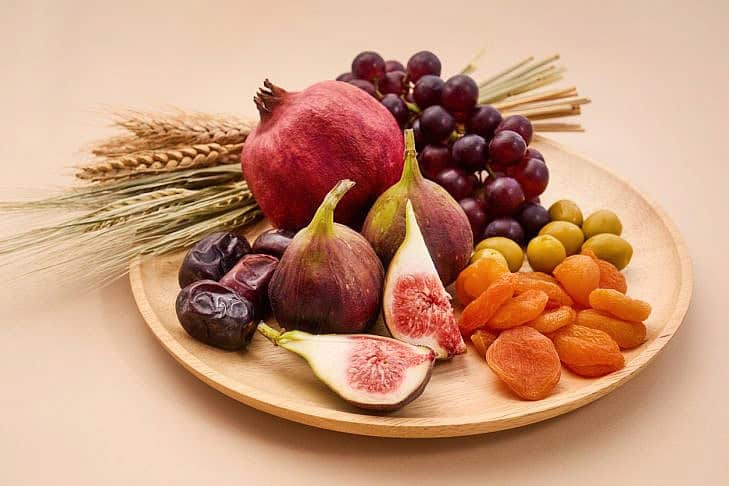
There’s a special kind of ironic joy in scrolling through Jewish Instagram on Tu B’Shevat and seeing people lovingly photographing their figs, dates, etrog jam, and ethically sourced pomegranate seeds with the perfect filter; somehow, one day a year, we all become part-time fruit influencers. Only the Jewish people could take a minor holiday about trees and turn it into an existential‑spiritual charcuterie board about produce.
But here’s the thing that always gets me: Tu B’Shevat shows up in the middle of winter. In Massachusetts, it feels less like a holiday and more like a dare. I’m sure it feels a little more relevant in warmer climates, but really, our version makes the most sense. Stick with me for this one.
Friends, I know the rabbis weren’t freelancing. And I know that according to Hillel, the flowers on the almond trees are blooming on the 15th of Shevat in Israel, so that’s what gifted us this mid-winter celebration.
But here?
Tu B’Shevat drops in mid-winter, when the only things growing in New England are ice dams. It’s still audaciously aspirational to look around at the snow drifts and frozen ponds…and then eat dried apricots and sing about baby pine trees in the Judaean Hills.
And yet this is exactly why I love it. Because Tu B’Shevat looks at the world and says, “Dream on.” Dream on when nothing is blooming. Dream on when the cold insists nothing can grow. Dream on because growth begins long before it’s visible.
And honestly? That’s us. That’s the Jewish story.
We’ve dreamed through exiles, through winters far colder than this one, through nights when hope felt like a fragile, unreasonable choice, and we chose it anyway; we don’t wait for spring to believe in renewal. We dream not because the world makes room for our dreams (it rarely does), but because our ancestors taught us that dreaming itself is a form of survival.
After all, anyone can celebrate growth when everything is green; it takes chutzpah to celebrate it in February. Tu B’Shevat reminds us that the world doesn’t have to look ready for hope before we plant some.
So, in the bleakest stretch of the year, we gather, we bless, we eat our fruit, and we whisper to the stubborn, sleeping trees, and to ourselves:
Dream on.
May your trees flourish, your fruit be photogenic, and your hope, ridiculous as it sometimes feels, take root.
This post has been contributed by a third party. The opinions, facts and any media content are presented solely by the author, and JewishBoston assumes no responsibility for them. Want to add your voice to the conversation? Publish your own post here. MORE