





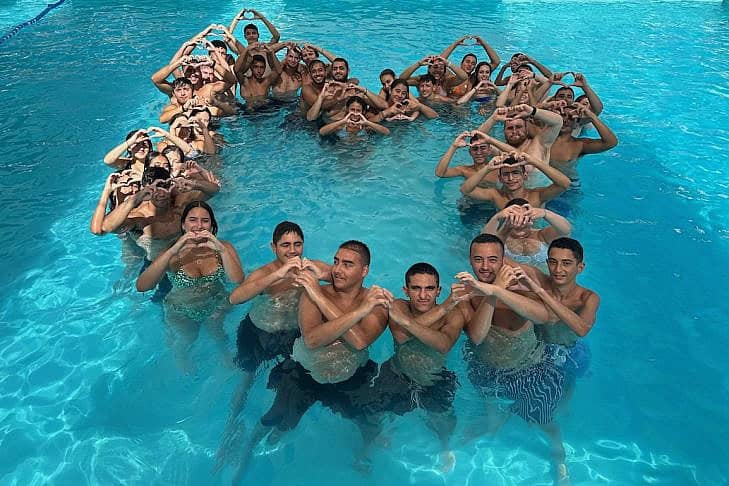
Going to summer camp involves big emotions: excitement, homesickness, freedom. For kids in Israel, the experience is even more meaningful: It’s a respite from a world that can feel scary and unpredictable.
Camp Boston Sderot provides a two-week overnight oasis for 80 kids living in Sderot, Israel, recovering from the attacks of Oct. 7, 2023. It’s affiliated with Camp Sunapee, a Russian School of Math camp in Springfield, New Hampshire. American counselors travel to Israel to support kids ages 7 to 18 with sports, arts and English lessons (no math).
This year, Sunapee alum and counselor Daniel Cutler, 19, directs Camp Boston Sderot. He chatted about the camp’s mission and fundraising efforts.
What’s the Boston connection?
Ever since I was 10 years old, I’ve been going to a camp outside of Boston called Camp Sunapee. It’s related to the Russian School of Math. A big group of mostly European, first-generation immigrant Jews go to summer camp there. In 2007, the daughter of the founder of our camp went to Sderot, Israel, as a journalist. She essentially ended up in the middle of an attack on the city and said: “We need to do something.” That was the catalyst for the foundation of this program, which is based in Israel and has been running ever since. Every year, we get a lot of counselors from Boston and a lot of fundraising support from Boston. We’re always happy to take counselor applications. We love getting the community involved.
In 2024, due to the war, we were unable to host the camp in Israel, so we brought 20 of the kids who go to the camp in Sderot to the United States. This is something I care about very deeply, and I’m very excited to be doing it. I’ll be planning the itinerary, doing fundraising and helping counselors with their own fundraising. This week, we’re flying one of the counselors —an ex-IDF soldier from Sderot — to the U.S. to speak about the program and her experiences.
What does this fundraising support?
The children in Israel don’t pay to attend the camp, so our fundraising supports running the camp: food, materials, the campground and travel for counselors. It’s a completely unpaid, volunteer camp.

Tell me about the camp’s mission.
It’s like a normal summer camp: outdoor activities, fun traditions, bonding. Every day, there’s also English class. Otherwise, it operates as a fun summer camp for kids to enjoy.
Why is this so camp important? What makes it different?
It’s really eye-opening to understand what a normal reality looks like for a kid in Sderot, especially since Oct. 7. There isn’t a single person there who hasn’t been affected and who hasn’t seen death. It’s just a completely stark, different reality than what we’re lucky enough to grow up with here in the U.S. We’re showing the people in Israel that there are Jews across the world who care to visit them and want to bond with them. It’s really been very beautiful to see. We’re giving them a break and some time to just be kids.
The issues faced by these campers are so different from the issues that many kids in the U.S. might bring to camp. What are the social and emotional considerations?
Obviously, safety is a huge concern: making sure that we’re always coordinating with the parents, making sure there’s not an imminent threat within the camps, that there are bomb shelters in the right places and that everybody has the right technology on their phones. In Israel, everyone has to make sure they have the right safety monitoring apps.
But it’s amazing how strong they are, and how willing they are to talk about their situation. Especially over the past few years, there’s been a lot of grieving from the campers. It was really important for us in 2024 when we brought campers from Israel to the U.S. that we talked about Oct. 7. This made some of these younger campers who maybe didn’t fully grasp the situation aware of what was going on. We did ask a lot of them to speak about their experiences, but as you can imagine, it was extremely difficult for them. It’s hard to understand. It’s hard to put yourself in the shoes of someone who has experienced that kind of loss and is constantly going to bomb shelters throughout the day; their house is literally shaking. But it’s really important as a Jewish community that it’s something we share.
What does a typical camp day look like?
In the morning, we do stretches, exercise, bring everyone together and listen to music. Then, as a camp, we typically go to breakfast and sit together to eat. Then we have activity periods. Kids can sign up to play soccer, basketball or do art activities. Then we go to the pool on the campground, if it’s available. That’s a big consideration, especially in Israel, where it’s extremely hot. That’s one of the kids’ favorite times of the day by far. After that, we’ll usually have some time to change before going to lunch. After lunch, the kids will have a few hours of English class. Then, the kids hang out in their cabin, play cards and get ready for dinner. At night, we have unique activities — games, competitions, performances, talent shows.
What else would you like the JewishBoston audience to know?
Everybody is welcome. The entire idea is bringing together the Jewish community in Israel and the U.S. I’d like to thank all the counselors going to Israel this year. It makes me very proud to be part of a community where people are willing to go during a time when it’s not necessarily entirely safe. It’s really beautiful to see.
The program is supported by the RJCF Children of Sderot Fund. Learn more about this project by following Camp Boston Sderot on Facebook and by reading the Sderot Journal page.