





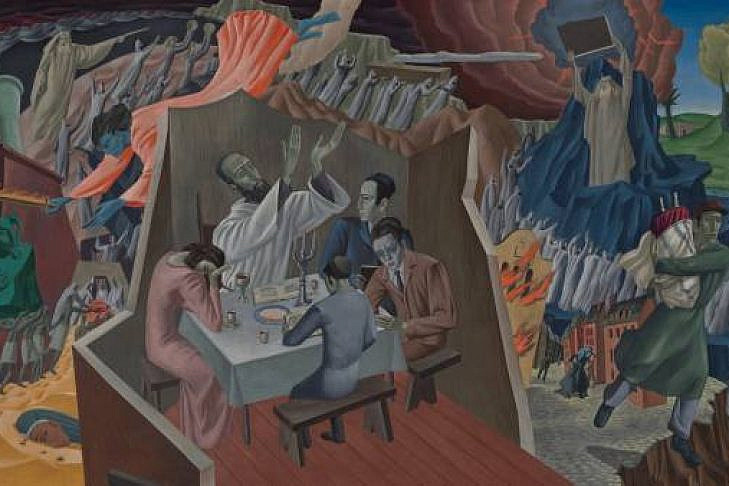
It’s not every day that the Museum of Fine Arts, Boston, acquires a painting that confronts the Holocaust, let alone one created by a painter in America as it was happening.
In 2025, the MFA acquired “Bread of Affliction,” a powerful painting by American artist Nathaniel Jacobson. Jacobson painted the work in 1940, before the United States entered World War II and before the full scale of the Holocaust was widely understood. An American Jew, he saw what was happening across Europe and used his paintbrush to document it. The fractured style feels reminiscent of Pablo Picasso’s 1937 “Guernica,” a monumental painting created during the Spanish Civil War. But where the center of “Guernica” is a horse, at the center of “Bread of Affliction” is a Passover seder.
This acquisition is notable because of the content, because Jacobson was a celebrated painter of his generation, and because he was a son of Jewish Boston. The MFA received “Bread of Affliction” as a gift from the artist’s family, following a request in his will. Jacobson’s son, Joshua Jacobson, is founder and director of the Zamir Chorale of Boston and a longtime professor of music, colleague, and friend. Josh told me how much it means to him and his brother to honor their dad’s legacy by gifting this painting to the MFA, so I asked him to tell me: If you wrote a bio for your dad, what would it be? Here’s his response:
Nathaniel Judah Jacobson was born in 1916 in Salem, Massachusetts, the youngest child of an Orthodox rabbi. He grew up in the predominantly Jewish Roxbury neighborhood, where his parents ran Boston’s premier kosher catering hall, The Aperion Plaza. While his older siblings helped out in the family business, Nathaniel’s interests lay in another area: visual art. He loved to draw, and when possible, he would walk the three-and-a-half miles from his home in Roxbury to visit Boston’s Museum of Fine Arts.
Although they perhaps didn’t understand their youngest son’s passion, his parents didn’t stand in his way. After graduating from Roxbury Memorial High School, Nathaniel went on to study at the Massachusetts School of Art (now the Massachusetts College of Art) and then Yale’s School of the Fine Arts.
At Yale he was fascinated by exhibits of Early Renaissance art, and tried his hand at painting in the medium of egg tempera. His painting “The Bread of Affliction” (1940) dates from that period and received recognition in the prestigious Carnegie Institute’s 1941 “Directions in American Painting” exhibition.
In 1944 Jacobson left his young wife and newborn son to serve in the U.S. Army in Europe, working primarily in camouflage. His experience in the Second World War left a tremendous emotional scar. The only paintings that he managed to produce after returning home were joyless and dark.
But all that changed in 1956 after his first trip to the new State of Israel. Inspired by the rejuvenation of the Jewish people, Jacobson’s works were now full of light and joy. He frequently visited Israel both for inspiration and to visit his older son and grandchildren.
Making a living as an artist was not an easy task, even while married to a woman who maintained a career as an interior decorator. He also received a number of commissions for murals, tapestries, and stained-glass installations, mostly in synagogues. In addition, he was commissioned to paint portraits of prominent Bostonians. But exhibits and sales of his own paintings were infrequent.
Later in life Jacobson returned to an interest that had captivated him in his student days: the theory of color. He devised a comprehensive system for identifying colors (by classification of hue, value, and chroma) and evaluating the effects of various color combinations. His work eventually led to a collaboration with academics at MIT’s Media Lab and a contract with Binney and Smith to use his system to identify every tube of paint that they manufactured.
Throughout his life, Jacobson remained a practicing Orthodox Jew, and the Jacobson home in Brookline was well-known for its hospitality. The Shabbat table always included guests and was filled with stimulating conversations on art, politics, or the weekly Torah portion, as well as the robust singing of zemirot, traditional Sabbath hymns.
Nathaniel Jacobson died from the complications of cancer in his home surrounded by his family in January 1996, just two months short of his 80th birthday.
This acquisition is made possible by a unique collaboration between two areas of the MFA’s collection: Judaica and contemporary art. Simona Di Nepi, the museum’s Charles and Lynn Schusterman Curator of Judaica, worked with Ethan Lasser, Chief of Curatorial Affairs and Conservation, to bring the painting in. That partnership reflects the work’s unusual reach: it is at once an important example of American modernism, a work of Jewish visual culture, and a historical response to the gathering tragedy in Europe.
At The Vilna, we’re excited to welcome Simona Di Nepi, Ethan Lasser, and Joshua Jacobson for a special conversation on Dec. 2 from 7-8:30 p.m. (register here). Together they will explore Nathaniel Jacobson’s life, the story behind “Bread of Affliction,” and what this haunting work means for the MFA and for audiences today. Join us live for the full conversation, and watch for a portion to air on International Holocaust Remembrance Day on Jan. 27, 2027, helping this extraordinary painting carry its message of memory, warning, and resilience to audiences everywhere.
This post has been contributed by a third party. The opinions, facts and any media content are presented solely by the author, and JewishBoston assumes no responsibility for them. Want to add your voice to the conversation? Publish your own post here. MORE