





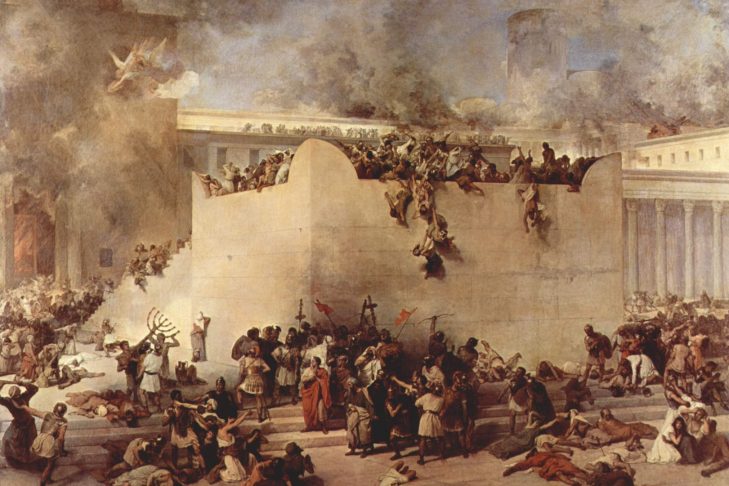
This week, we arrive at Shabbat Nachamu. Named for the opening words of the Haftarah reading in Isaiah, chapter 40 “Nachamu, nachamu ami” (“Comfort, comfort My people”), we are supposed to usher in a period of healing after experiencing the devastation of Tisha B’Av.
Given our experience and our return to Zion, back in the days of Ezra and Nehemiah, and again in modern times, it makes sense to allow ourselves the full range of sadness and comfort on this Shabbat. Time and time again, destruction and exile in our history have been followed by eventual redemption.
But today, what if the comfort doesn’t come?
What if, like Rachel weeping for her children (Jeremiah 31:15), we refuse to be comforted? What if we look around as proud Jews in a world that still burns with Jewish hatred, in a time when fear and isolation shape our Jewish experience on the regular, and feel that Isaiah’s words no longer land?
I, for one, am not comforted.
Isaiah spoke to a broken people on the verge of exile, reassuring them that God had not abandoned them. His message was at once poetic and prophetic: Justice would be restored, the crooked made straight, and Jerusalem redeemed. He saw beyond the impending catastrophe and a ruined city and into a time of restoration and return.
For Isaiah, like most prophets, one can imagine this was a hard sell. Most of us are limited in our prophetic capabilities, and even on a good day, it’s hard to see past the calamity of the moment. Even when the people cried out in despair, Isaiah insisted that divine love and protection would never abandon them. “I have engraved you on the palms of My hands” (Isaiah 49:16), he declared, reminding us that we are not forgotten, no matter how hopeless we may feel.
But what happens when we don’t feel held, remembered, or protected?
I don’t know about you, but right now it’s hard for me to see beyond the wreckage. Isaiah might tell me to be comforted, but I do not feel consoled.
Where is the prophet who will speak of a future not resplendent with blood libels, antisemitism, the demonization of Israel, and the “Jewish tax” we pay for security, but one of peace, harmony, and just being left alone?
Who, and where, is Isaiah now?
The new Isaiah is probably not standing on a hill sharing divine visions. Maybe the new Isaiah is the Jew who wears a kippah on a college campus, or a Jewish star around their neck at Concord-Carlisle High School. Maybe it’s the Jew who still makes Shabbat dinner weekly or has the temerity to wear a Hebrew-lettered Red Sox jersey in public. Maybe it’s the Jew who shows up to services, or teaches religious school, or volunteers on their synagogue board.
Isaiah is all of us who still choose to belong. We must be doing these things for a reason.
Isaiah didn’t just foretell redemption; he demanded justice, believed in the Jewish people, and trusted in God’s future. At the same time, he didn’t downplay the devastation, he just asked us to believe that the suffering wasn’t the end of the story.
Even in the most trying of moments, there must be hope. Not the false prophecy of quick fixes and easy answers, but the ancient hope that has always carried the Jewish people through trying times. A hope that insists on rebuilding, and that returns, over and over, to the text, to the land, and to each other. That looks at the ruins and still dares to begin again.
The comfort of Shabbat Nachamu doesn’t erase our sorrow; it merely reminds us that it is not the end of the story. The work of Isaiah, whether it be speaking truth, demanding dignity, holding onto holiness, or daring to believe in a better future, is now ours to continue.
That work can never end. Better days must lie ahead; we must challenge ourselves to envision them.
This post has been contributed by a third party. The opinions, facts and any media content are presented solely by the author, and JewishBoston assumes no responsibility for them. Want to add your voice to the conversation? Publish your own post here. MORE