




Conversations about Israel can sometimes feel like a giant game of telephone. A message is whispered from one end of a circle to the other, getting misheard, misunderstood, or picked apart with each repetition. Sometimes the message is intentionally distorted to support any one of an endless number of narratives. Other times it’s altered with a particular ideological viewpoint. The message shifts, drifts, and becomes increasingly distorted. It’s amusing when it’s a game; less so when it’s a real story with life-or-death implications.
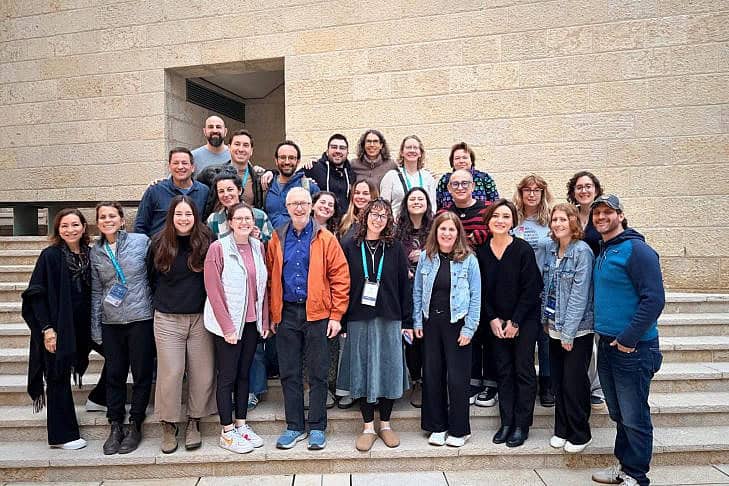
Combined Jewish Philanthropies (CJP), Greater Boston’s Jewish Federation, has partnered with The iCenter, a nonprofit focused on advancing Israel education, to operate a fellowship program, Groundworks. Last year, the immersive initiative convened 19 Jewish educators from day and public schools across the region to push back against “message drift” often seen in topics related to Israel. Groundworks also empowers educators by engaging with experts, participating in a vibrant community of educational practice, and traveling to Israel on a journey of education and discovery.
As educators, we are not simply participants in the circle; we often begin the whisper. We shape how Israel is introduced and understood by our learners and families. Between headlines, community debates, and classroom conversations, the message shifts. Nuance gets flattened, complexities become slogans, and emotion replaces context.
Our job is not to hand learners a message and expect them to carry it forward. It is to build their capacity to stay connected through disagreement, to ask better questions, and to keep people at the center of the conversation even when the environment demands we choose a side. In Jewish education, we cannot afford to pass along a fragile whisper. Israel education is not information transfer; it is identity formation. It shapes how the next generation understands Jewish peoplehood and their place in the Jewish story.
In a post-Oct. 7 world, we cannot afford educators improvising the hardest conversations of our time. The stakes are too high for superficial preparation. Educators are being asked to hold learners’ fear, parents’ grief, and communities’ polarization, often with little support. As Israel faces a widening regional war, the need for educators who can hold complexity with discipline and humanity is even more urgent.
At the center of the fellowship was a four-day trip to Israel built around formation and accountability. There was no visit to the Carmel Market, no pre-dawn hike up Masada, nor an afternoon at the beach. Instead, there were difficult conversations and lived testimony: families grieving children lost on Oct. 7, an Israeli voice from a settlement community, perspectives from across the political spectrum, and teenagers in mechina (Israel Defense Forces gap-year preparation) speaking about responsibility before enlisting in the IDF.
The weight of this responsibility became visceral at Kibbutz Re’im, where we sat with Shira, the sister of Ran Gvili. Ran was a police officer kidnapped on Oct. 7, and for months, his family waited in the agony of the unknown. His remains were eventually identified as those of the last hostage to be returned to Israel, a homecoming of the most somber kind.
As Shira spoke, our conversation was punctuated by the heavy, rhythmic blasts of artillery coming from the nearby Gaza border. She spoke of a “miracle,” not the kind we usually teach about in Hebrew school, but a devastating, modern one: the return of Ran’s body for a Jewish burial. She told us that for her family, this was a sign; it was the first time since 2014 that there were no hostages from Israel left in Gaza.
In that moment, the telephone game stopped. To an outsider, “miracle” and “death” are contradictions. But sitting with Shira, our educators had to hold both. They weren’t just collecting a story to repeat; they were wrestling with the agonizing weight of Pidyon Shvuyim (redeeming captives) while standing in the literal crosswinds of a regional conflict.
In a world that rewards immediacy, this approach is countercultural. Our feeds are loud, and communal conversations often move faster than reflection. CJP has invested in structured learning and skilled facilitation, not one-off programming. This fellowship intentionally slowed the noise and treated Israel education as serious professional work requiring disciplined preparation and moral clarity.
If the game of telephone is inevitable, we have a choice. We can contribute to distortion, or we can strengthen the whisperers. Groundwork is a statement that educators are frontline shapers of identity. Their preparation deserves communal investment. If we say Israel education matters, we must fund the conditions that make it possible: time for learning, guided reflection, and a community that has educators’ backs.
Not everyone can travel to Israel, but we all benefit from educators who are prepared to hold complexity for our children. True Israel education requires choosing depth over immediacy; it demands rigor, structure, and communal backing.
To communities watching from the outside, the takeaway is clear: investing in educator readiness is a primary strategic priority. Beyond checking a box, it ensures those guiding our families lead from a place of having seen, listened, and wrestled themselves.
Because when the story of Israel gets distorted, we don’t just lose knowledge. We lose connection and belonging. Strengthen the educators, and you strengthen the future of Jewish life in Greater Boston and beyond.
Zach Goldberger is associate director of Israel connections at CJP.
Dan Tatar is interim chief executive officer at The iCenter.