





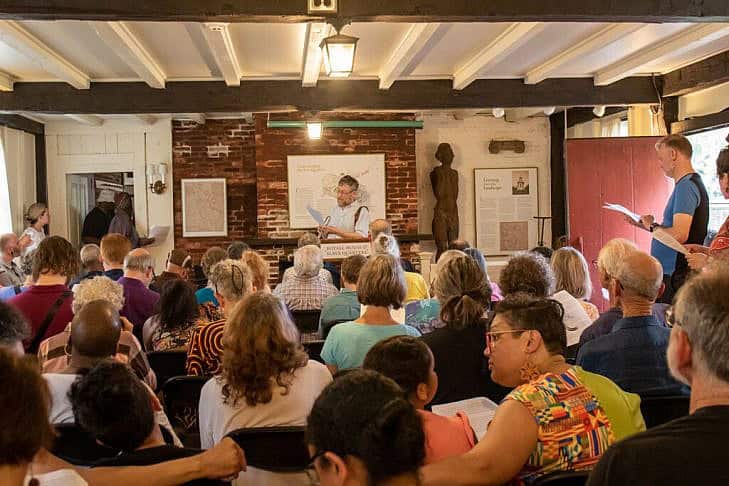
The year 2026 marked an extraordinary milestone in American history—the 250th anniversary of the signing of the Declaration of Independence. Across the nation, communities celebrated the country’s founding while also considering the ideals that have guided America for two-and-a-half centuries: liberty, equality, civic responsibility, and the ongoing chase of a more perfect union.
In Massachusetts, one of the most meaningful ways to commemorate this historic anniversary was through Reading Frederick Douglass Together, a statewide initiative organized by Mass Humanities. Rather than simply celebrating Independence Day, the program invited communities to revisit Frederick Douglass’s powerful 1852 speech, “What to the Slave Is the Fourth of July?” His words encourage Americans to celebrate the nation’s achievements honestly—recognizing both the extraordinary promise of the nation’s founding principles and the responsibility each generation shares in making those ideals a reality for everyone.
The Jookender Community Initiatives, Inc. was honored to be among more than 70 organizations across the commonwealth participating in this year’s initiative. Our event, however, looked a little different. Instead of gathering in a museum, park, or university auditorium, we brought Frederick Douglass’s words into one of the places where our community feels most at home—our annual June Family Camp. It proved to be the perfect setting.
Surrounded by children, teenagers, young adults, parents, and grandparents, the reading became much more than a historical presentation. It evolved into an intergenerational conversation about freedom, justice, memory, and the responsibility every generation carries in preserving the values that strengthen both communities and democracy. Many participants were hearing Douglass’s speech for the first time. Others recognized themes that corresponded with stories handed down through their own families. Instead of simply listening, people reflected together, asked reflective questions, shared personal experiences, and explored why a speech written nearly 175 years ago continues to motivate and inspire readers today.
For Jookender, those conversations naturally reached beyond American history. As a secular Jewish community organization, much of our work centers on Jewish history, identity, cultural memory, and cultivating community throughout generations. What surprised many participants was how naturally the event’s format echoed Jewish traditions of learning.
For thousands of years, Jewish education has been rooted in reading fundamental texts aloud, asking difficult questions, debating different interpretations, and encouraging every generation to become part of the conversation. Learning is not meant to be passive—it is something experienced together.
Our Reading Frederick Douglass Together event reflected that same spirit. Participants did not simply listen to a historic speech. They discussed it, questioned it, connected it to their own lives, and explored what its message asks of us today.
Many participants also recognized another meaningful connection. Every year during Passover, Jewish families gather around the seder table to retell the story of the Exodus—a journey from slavery to freedom. The purpose is not simply to remember an ancient event, but to ask what freedom means in every generation and what responsibilities accompany it. Although the Exodus and Frederick Douglass emerged from different historical experiences, they lead us to consider many of the same enduring questions:
-
- What does freedom truly require?
- How should societies remember painful chapters of their history?
- How do we preserve human dignity in the face of injustice?
- What responsibilities do those who live in freedom have toward others?
Our discussion was never about comparing one people’s history with another’s. Rather, it became an opportunity to appreciate how different cultures preserve memory, pass values from one generation to the next, and remain striving toward a more righteous and caring society. While every community carries its own unique history, many of the lessons those histories teach are remarkably universal.
Our Family Camp added yet another meaningful dimension to the conversation. Jookender brings together families from many backgrounds—American-born Jewish families, immigrants from the former Soviet Union, refugees from Ukraine, interfaith families, and many others who now call Massachusetts home. Around one discussion circle sat people whose families remembered antisemitism in Eastern Europe, others whose lives had been affected by more recent wars and displacement, and younger participants encountering Frederick Douglass’s words for the very first time. Each person gave a unique perspective. Kids listened as adults reflected on history. Parents heard meaningful questions from their teenagers. Grandparents shared wisdom formed by decades of life experience. For a moment, history was no longer something confined to textbooks. It became a living conversation between generations.
That experience reflects what Jookender strives to create through many of its programs: opportunities for people of different ages and backgrounds to learn with one another rather than separately. Some of the most meaningful education happens not only in classrooms, but around shared dinners, while walking through nature, beside a campfire, or sitting together in a community circle where all opinions matter.
As America celebrated its 250th anniversary, our community was reminded that commemorating history is about much more than honoring important dates or remembering outstanding individuals. It is about prolonging the conversations those moments inspire.
By bringing together Frederick Douglass’s vision of justice, Jewish traditions of learning and remembrance, and the different experiences of today’s families, our Reading Frederick Douglass Together event became far more than a public reading. It became an opportunity to reflect on freedom—not only as a historical achievement, but as a shared responsibility that each generation inherits.
We are deeply grateful to Mass Humanities for including Jookender in this year’s Reading Frederick Douglass Together initiative and for creating opportunities for communities across Massachusetts to participate in thoughtful civic dialogue during America’s 250th anniversary.
We are equally grateful to Combined Jewish Philanthropies (CJP), whose longstanding partnership and ongoing support of Jookender make programs like this possible throughout the year. Their investment in Jewish community life allows us to create warm spaces where families of all generations can explore history, identity, civic engagement, and the values that unite us.
Perhaps that is exactly why initiatives like Reading Frederick Douglass Together matter. They tell us that history is not meant to be viewed from a distance. It is meant to be read aloud, questioned, discussed, and carried forward. Two-hundred-and-fifty years after America’s founding, the conversation about liberty continues—and every new generation deserves a seat at that table.
At first glance, reading Frederick Douglass at a Jewish family camp may seem unexpected. By the end of the afternoon, however, it felt entirely natural. Jewish tradition teaches us to remember the journey from slavery to freedom. Frederick Douglass challenged America to remember its own unfinished road toward justice. Together, these stories invited our community not only to reflect on history, but also to consider how each of us can help build a society that is more welcoming, more compassionate, and more just for future generations.
For us, the conversation did not end when the reading concluded. Like the traditions that inspired it, it continues every time our community gathers to learn, to listen, and to grow together.
This post has been contributed by a third party. The opinions, facts and any media content are presented solely by the author, and JewishBoston assumes no responsibility for them. Want to add your voice to the conversation? Publish your own post here. MORE