





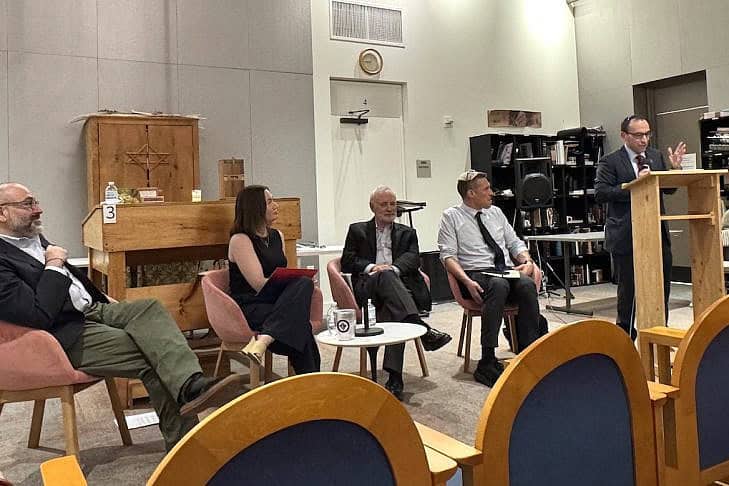
On Tuesday, April 14, Rabbi Marc Baker, CJP’s president and CEO, joined a powerful conversation hosted by Interfaith America — Lighting the Way: Jewish Reflections — a panel at the Miller Center for Interreligious Learning & Leadership at Hebrew College that brought together Jewish leaders and thinkers to reflect on pluralism, democracy, faith, and moral responsibility in a moment of deep national and communal uncertainty.
In his remarks, Marc reflected on the urgency of pluralism as both a civic and spiritual practice. Drawing on Jewish teachings, his own years in Jewish educational leadership, and the work of building community across difference, he spoke about dignity, responsibility, love, and the obligation to stay in relationships, even when it is hard to do so. Together, his words offered both an acknowledgment of the moment we are living in and a hopeful vision of bridge‑building, moral courage, and choosing light — even in precarious times — to guide the way for the next generation of joyful, proud Jews.
Below are Marc’s remarks as delivered at the panel.
I cannot remember a time when things, including but not limited to our democracy, felt more fragile than they do right now.
But conversations like this give me hope, so thank you all for being here tonight.
As do gatherings like today and the work that Interfaith America is doing across this country every day, having the courage to ask questions like the ones we heard just on this panel tonight: How do we relate to one another? What does God call me to be? What do we do with our shadow?
The willingness to have these conversations and ask these questions is a form of spiritual resistance against all the voices that tell us this isn’t possible or it’s not worth it.
Building bridges and having conversations like the one we had tonight are ways to expand our minds and hearts so that we can reject false binaries, hold more nuance, more competing truths, and more empathy than we think we’re capable of holding.
I spent the first 20 years of my career working in pluralistic Jewish high school education, inspired by many of the sources that you all quoted tonight.
I continue to believe that one of the most important and urgent ways we in our community and in this country can heal our society and our world is by developing a next generation of confident, compassionate, joyful, proud young adults who have practiced and internalized the habits of mind and heart of pluralism.
I moved into the leadership of CJP in part because I came to believe that these habits of heart and mind are as, if not more, important for our entire Greater Boston Jewish community.
This means re-weaving the ties that bind us, reaffirming the values we share and the common good for which we strive, engaging passionately with one another, not despite, but because of, our differences.
Our Jewish intellectual, moral, and spiritual traditions give us a blueprint for doing this work, and I really believe we can be a laboratory, and perhaps even a tikkun, a repair, that our country needs so desperately right now.
When I think about what this means, I want to share three of my core beliefs and commitments.
The first is the simple but profound belief that every human being is created in the image of God, Betzelem Elohim, which mandates the dignity of difference, as Rabbi Jonathan Sacks wrote, and also mandates a commitment to Kavod Habriot, Ahavat Habriot, and Ahavat Yisrael, respect for and love of every Jew and every human being.
I used to tell my high school teachers who were having a hard day before they went back into the classroom: “Remember, you don’t have to like them. You just have to love them.”
And I really believe this should be an ethos of leadership, citizenship, and community. We don’t need to like every person, and we certainly don’t need to like their views or behaviors. But we do need to love them.
For me, sometimes the people whom I find it hardest to like are the ones I most need to love. They need it, and I need it.
My second belief is in what our Jewish tradition would call Kol Yisrael Arevim zeh l’zeh — we are all bound up together and responsible for one another. Or, what Parker Palmer calls “true community.”
“True community,” he says, “is that place where the person you least want to live with always lives.”
Contrary to echo chambers and homogeneous communities toward which it is so natural for us to gravitate, true community means being in relationship with people to whom I am not yet proximate enough, and, sometimes, with whom I least want to be in relationship.
My third belief is about history. This country, like the Jewish people, was founded with a profound sense of its own story, and its place in the political, social, intellectual history of the world. Bold, revolutionary ideas like pluralism and democracy require knowledge of our history, including the times when citizens and leaders have and have not lived out these ideals.
This knowledge empowers each generation, not only to know our shared story, but to actively participate in the writing of the next chapters of that story.
I fear that we are neglecting the teaching of history. That we are not fulfilling the Torah’s sacred obligation of V’higadita L’Bincha — you shall pass on to your children our people’s story, our nation’s story. Telling and retelling our stories of the past, both the beautiful ones and the messy ones, brings inspiration and joy, and also reverence and responsibility.
I recently read a beautiful quote by David McCullough about the teaching of history. He says: “History encourages, as nothing else does, a sense of proportion about life. Gives us a sense of the relative scale of our brief time on earth and how valuable that is. History shows us that times of change are the times when we most likely learn. History is an extension of life. It both enlarges and intensifies the experience of being alive. It is ours to enjoy.”
These beliefs and commitments animate my vision of bridge building, of pluralism, and democracy, all of which feel incredibly precarious right now. But the thing about things feeling precarious when you feel like you’re in an existential moment is that it’s really scary.
Things could go really badly. It’s also a profound sense that the choices we make today are going to shape, as you said in the beginning, the world that our children and grandchildren live in, and so, in that spirit of these choices shaping our future, I’ll close with the beautiful introduction by Jon Meacham to his book “The Soul of America,” which feels poignant and appropriate for a conversation like this.
He says: “In our finest hours, the soul of the country manifests itself in an inclination to open our arms rather than collect our fists. To look out rather than turn inward. To accept rather than reject. In doing so, America has grown ever stronger, confident that the choice of light over dark is the means by which we pursue promise.”
May we be blessed with the courage, clarity, and spiritual fortitude to keep choosing light and to play whatever small parts we can to illuminate the way for a better, brighter future.