





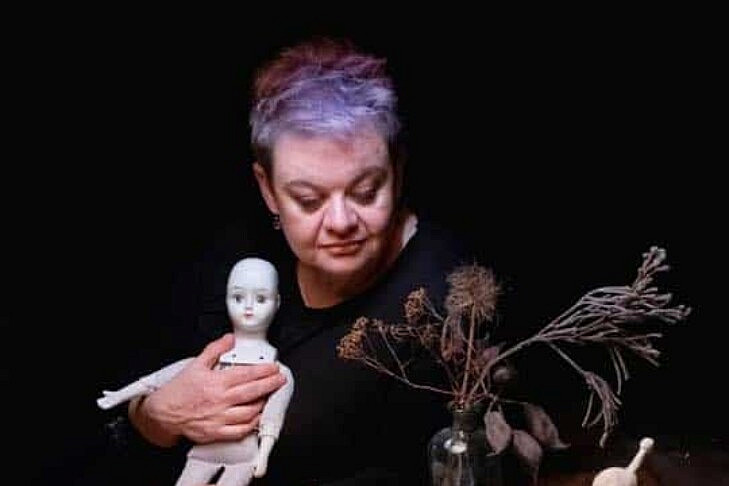
In 2025, artist Inna Zhukovsky Zilber was awarded her first-ever artist grant to create a piece about her life story and journey. Prompted by this, she came to The Vilna for the first time to understand if and how the space might host this exhibit.
I watched her eyes light up as she stepped into The Vilna Shul sanctuary for the first time. Born in Vilnius, Lithuania, I could immediately sense how at home she felt in the space. A deep recognition of history, memory, and belonging, the space sparked her immediately to begin thinking about an installation in the sanctuary, something never before done.
A year later, I stood in awe as Inna installed her multimedia exhibition, “Echoes of Home,” throughout the sanctuary. It is a deeply personal work that needed almost no explanation for me to feel immersed in her journey.
As we commemorate America’s 250th anniversary in the heart of Boston, Inna’s story is a powerful contemporary reminder of the immigrant journeys that shaped The Vilna, downtown Boston, and our country. Her work reminds us that immigration is not only part of our history—it continues to shape who we are today.
Because “Echoes of Home” is so layered and multifaceted, I asked Inna to share more about the ideas and experiences behind the exhibition.
The exhibition is called “Echoes of Home.” What places have you called home throughout your life, and how do each of those places find their way into your work?
The exhibition is called “Echoes of Home” because my work is deeply rooted in three distinct chapters of my life. First is Vilnius, Lithuania, my birthplace and ancestral foundation. Returning there decades later with my family to reconnect with my roots was the direct spark for this entire project, providing the physical objects and cultural memories that form its baseline. Next is Israel, where I grew up. That chapter infuses my art with the raw, emotional themes of migration, transition, and the search for belonging. Finally, there is the Greater Boston area, my current home. Presenting this history inside The Vilna—Boston’s last remaining immigrant-era synagogue building—creates a powerful parallel between my personal journey and the collective memory of the space.
To express these overlapping identities, I combine ceramics, textiles, watercolors, and found-object sculptures. Together, these diverse mediums transform the physical fragments of my life into a universal exploration of displacement and discovery.
You work so masterfully across many different media—watercolor, clay, wood, and found objects—and together they create such a vivid portrait of how you see the world. How did you begin imagining this exhibition? Which elements felt most essential, and how much of the work grew from existing pieces versus new creations?
I began imagining “Echoes of Home” not as a static display, but as an immersive dialogue with Jewish memory and displacement. The vision truly took shape when I saw the historic sanctuary at The Vilna Shul. Knowing this is the first contemporary art exhibition ever installed directly inside the sanctuary, I realized the building itself had to become part of the art. The space acts as a physical anchor for the memories I am trying to evoke.
The most essential elements were the contrasting textures and palettes that define my past. I needed the muted, raw linens and calm grays of my childhood in Lithuania to physically clash and blend with the vibrant, sun-drenched clay and bright colors of Israel. Clay feels ancestral and permanent, while textiles and watercolors feel fluid, like memories that drift. Found objects are the literal fragments of life left behind or discovered along the way.
As for the timeline of the work, it is a conscious mix of both existing pieces and entirely new creations designed specifically for this space. Many of my existing ceramic and textile works laid the foundation, representing years of processing my personal migration. However, the moment I committed to the historic sanctuary, the exhibit demanded new context. I created new site-specific installations to weave my personal journey directly into the architectural layout of The Vilna Shul, ensuring my personal past directly mirrors the collective immigrant history built into these walls.
Visitors will each bring their own memories and experiences of home into this exhibition. What do you hope they carry with them when they leave the sanctuary?
I hope they carry away a deeper understanding that home is not just a geographical place, but an internal landscape we constantly carry with us, lose, and rebuild throughout our lives. I want them to feel a profound sense of reconnection to their own personal roots and life chapters. While my art uses specific fragments from my own life, the emotional experiences of transition, changing identities, and finding your footing in a new phase of life are completely universal. Whether someone has moved across oceans or simply moved through different eras of their own life—like childhood, grief, or new beginnings—we all know what it feels like to leave a piece of ourselves behind.
Ultimately, I want them to experience a powerful connection between the art and the space. Standing inside The Vilna—a historic sanctuary built on layers of time and human transition—I hope visitors realize that our personal shifts are part of a much larger, collective human journey. I want them to step back out into the world feeling that no matter how much our external lives change, we always possess the power to carry our true home within us.
“Echoes of Home” is on view at The Vilna Shul from June 28 through Aug. 19, 2026, with support from CJP. We hope you’ll take the opportunity to experience this powerful exhibition and Inna’s story firsthand. Visit vilnashul.org for gallery hours and visitor information.
This post has been contributed by a third party. The opinions, facts and any media content are presented solely by the author, and JewishBoston assumes no responsibility for them. Want to add your voice to the conversation? Publish your own post here. MORE