




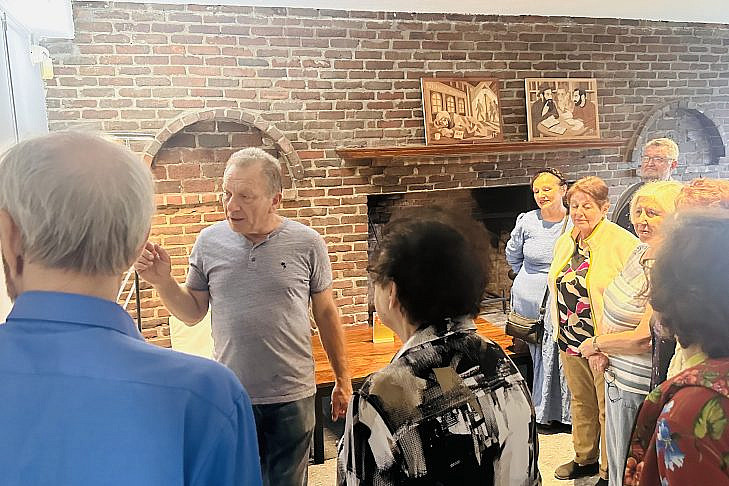
There is something deeply meaningful about witnessing an artist at the moment when their work begins to speak not only to themselves, but to a wider world. The recent solo exhibition of Michael Farro at Jookender was exactly that kind of moment—quietly powerful, deeply personal, and profoundly connected to history, memory, and identity.

This exhibition did not begin as a certainty. It began, as many things at Jookender do, with a first step. Back in October 2025, during a community-centered exhibition dedicated to senior citizens, Michael presented just two of his works. Those pieces, intricate and contemplative, stood out—not because they demanded attention, but because they invited it. They revealed patience, discipline, and a rare sensitivity to material and meaning. That was enough. The trust has been earned not through volume, but through depth. From that moment, it became clear that Michael was ready for something larger—a full solo exhibition.

At Jookender, growth often happens organically—through relationships, trust, and community engagement. Jookender itself is not an art gallery in the traditional sense. It is a community-driven organization serving local families, the Jewish and Russian-speaking Jewish communities, and broader audiences through a wide range of programs. These include youth and teen initiatives, college-level STEM and research internships, family camps, cultural events, and partnerships that bridge Jewish and non-Jewish communities. Art exhibitions are just one of the many ways Jookender brings people together—offering space for reflection, dialogue, and creative expression within a much larger ecosystem of community life.
Within that context, exhibitions play a unique role.

They allow emerging artists—many of whom may not yet have access to formal gallery representation—to present their work publicly, build confidence, and begin shaping their artistic path. Supporting these exhibitions fosters community pride and shared growth, making everyone feel part of something meaningful.

As one of Jookender’s co-founders, I bring to this process my experience owning and operating an art gallery. That background allows me to support artists not only in displaying their work, but also in understanding how to position themselves, present their portfolio, and navigate opportunities for future exhibitions beyond Jookender.

Michael Farro’s journey reflects this pathway in a particularly meaningful way, inspiring admiration and hope through his perseverance and dedication to his art and heritage. Born in Bobruisk, Belarus, into a family shaped by both education and historical trauma, his story carries the weight of memory across generations. Michael’s mother’s family was lost during the war. His father, a teacher of history and geography, contributed extensively to preserving local history, including research on partisan movements, despite being legally blind. These layers of personal and collective history are not distant influences—they are embedded in Michael’s artistic voice.
Professionally, Michael built a long and successful career in computer programming after immigrating to the United States in 1993. Art came later, sparked by a deeply personal memory: marquetry portraits gifted to his father. With no formal training available, he began teaching himself the craft just three years ago through books, research, and experimentation.
Marquetry is a demanding and meticulous art form. Each piece is created from carefully selected wood veneers, cut and assembled with precision. There is no room for error, and no quick corrections. A single artwork can take one to two months to complete, requiring both technical discipline and emotional endurance.

In Michael’s work, this traditional technique becomes a powerful vehicle for storytelling. His pieces presented at Jookender are deeply connected to Jewish history and collective memory. One of the central inspirations behind his recent works is the tragedy of the Oct. 7, 2023, Nova massacre—an event that continues to resonate across Jewish communities worldwide. Rather than replicating images, his work interprets emotion: fragmentation, silence, loss, and the lingering presence of trauma.
Alongside this, his compositions explore broader themes—the aftermath of war, the vulnerability of human life, and the persistence of memory across time. What makes his work especially compelling is the tension it holds: between the rigidity of wood and the fluidity of human emotion, between structure and rupture, between past and present.

At this stage, Michael’s works are not yet for sale, as he continues to develop and position his artistic voice. However, he is actively seeking opportunities to be featured in galleries in Boston and beyond. His next exhibition is already scheduled to open on April 30 at Center Makor in Newton, marking an important next step in his artistic journey.

At Jookender, we are proud to have been part of that journey.
At the same time, we recognize that art is just one dimension of a much broader mission. Jookender’s work spans education, cultural engagement, youth development, and community-building across generations and backgrounds. Supporting Jookender means supporting not only artists, but also students, families, and community members who find connection, growth, and opportunity through our programs.

As this exhibition comes to a close, what remains is not only a collection of artworks but also a story of trust, discovery, and a voice beginning to emerge.

And, as always, an open door. Artists interested in being featured in Jookender’s gallery as part of our broader community programming during the upcoming academic year are invited to reach out to me at jookender@gmail.com, opening doors to new creative opportunities and community recognition.
Because sometimes, within a community, even one exhibition can become the beginning of something much larger.
This post has been contributed by a third party. The opinions, facts and any media content are presented solely by the author, and JewishBoston assumes no responsibility for them. Want to add your voice to the conversation? Publish your own post here. MORE