





On Tuesday night, I was at the Garden for the Bruins game.
I was in a pretty good mood, with two of my kids by my side, as we settled into our seats. I love being there early — feeling the place fill up, hearing the music, watching the pregame video cycle through its rituals.
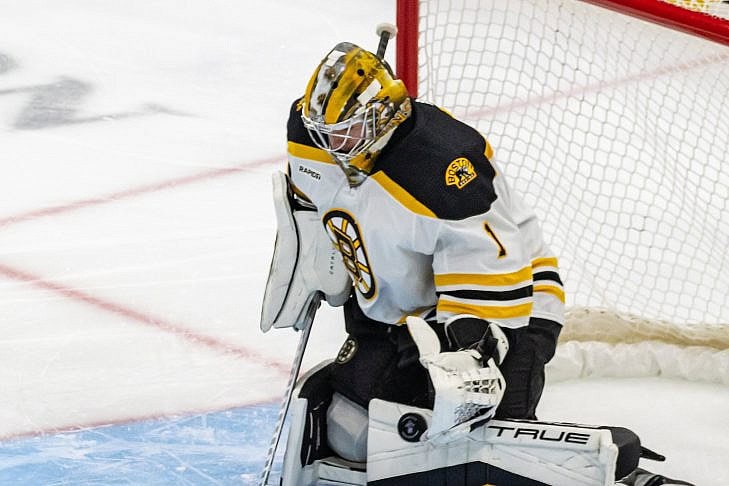
I was extra pleased because we walked in expecting a Korpisalo-in-net game and, lo and behold, Jeremy Swayman, the Alaskan Jew himself, took the ice and got the start.
After the requisite “Back in Black” warmup skate, the music quieted, and a “Happy Hanukkah” graphic flashed on the Jumbotron. As the crowd waited for the anthem, the arena grew nearly silent. I knew I had some time, so I did what any self-respecting Jew with a loud voice (and nothing to lose) would do.
“HAPPY CHANUKAH, JEREMY,” I shouted. And I do mean, shouted.
My daughter was mortified. I was thrilled. Everyone heard it. We were close enough that I’m sure he did too.
(It mirrored a 2023 moment, when I yelled, “Let’s go, Alicia!” to Temple Israel of Boston’s Alicia Stillman before she sang the anthem at Fenway on Jewish Heritage Night. Later, she told me how happy it made her; do you think Swayman felt the same way?)
I see you, fellow Jews. I really do. And I’m here for you.
Swayman, the Bruins’ number one goalie, is back in elite form after a rocky 2024–25 season. His excellence as a Jewish hockey player is no longer an anomaly; he’s part of a larger pattern.
Without getting too listicle-y, even a casual look across the NHL suggests something that didn’t used to feel normal: Jewish players aren’t just present in the league. They’re central to it.
In Boston alone, Swayman anchors the crease while Jordan Harris provides steady minutes on the back end (at least, when he is healthy, which he has not been this season). In New York, Adam Fox remains one of the league’s most complete defensemen, a Norris Trophy winner and a player teams plan entire seasons around. His excellence no longer needs framing or explanation; it simply sets the standard.
In Edmonton, Zach Hyman fills a different role, but an equally important one. He scores, yes (54 goals in 2022–23, and league-leading postseason production not long ago), but more than that, he plays the kind of game coaches trust in every situation. He goes to the hard areas, absorbs contact, and turns effort into results. On a roster filled with generational talent like Connor McDavid and Leon Draisaitl, Hyman has made himself indispensable.
The Devils offer a glimpse of what comes next, with brothers Jack and Luke Hughes both playing important roles for a team on the rise. Jack, the first overall pick in 2019, has already rewritten franchise records and should factor prominently into the U.S. Olympic team in Milan, once healthy. There is no sense of novelty here, only expectation.
Jakob Chychrun, now with Washington, further underscores the shift. A big, physical defenseman just hitting his prime, Chychrun just signed an eight-year, $72 million extension and logs heavy minutes against top competition.
The list does not end there.
All of this sets the stage for one of the most high-profile (and unusual) trades in recent NHL memory.
Last week, Norris Trophy winner Quinn Hughes (the brother of Jack and Luke) was traded from Vancouver to Minnesota; Hughes is a legitimate star, a Norris winner, and will be an All-Star for the foreseeable future. Stuck on a flailing Canucks team (with two other Jewish players, btw), he made it clear he wanted out. That, in and of itself, is not that surprising. What is surprising is who the Wild sent back: a substantial package headlined by Zeev Buium, an Israeli-American dual citizen and one of the league’s most exciting young defensive prospects.
A Jewish defenseman for a Jewish defenseman. Clean. Direct. Almost unremarkable…which is precisely the point.
Not long ago, this would have been treated as a curiosity; today, it barely requires explanation. These are simply elite assets, fairly exchanged.
Taken together, this feels less like a coincidence and more like a turning point. Jewish players are trusted with franchises, minutes, contracts, and expectations. They are no longer exceptions. They are part of the league’s DNA.
Sitting at the Garden with my kids, watching Swayman settle into the crease and earn the victory, it struck me how quiet this shift has been. No declarations. No banners. Just a natural progression. We are here.
It’s a lovely and warm reminder that history doesn’t always announce itself when it changes. Sometimes you only notice later, when something that once felt remarkable starts to feel normal.
That’s the kind of normal I could really get used to.
This post has been contributed by a third party. The opinions, facts and any media content are presented solely by the author, and JewishBoston assumes no responsibility for them. Want to add your voice to the conversation? Publish your own post here. MORE