




For many families, Hebrew is more than a language: it’s the portal to Jewish life. But learning a new language is difficult, especially for people with learning disabilities.
The multi-sensory Hebrew Decoding Program from Gateways: Access to Jewish Education changes that. Boston-area learners with dyslexia and language-based learning differences have used the program for decades. Now, their self-paced curriculum is available online, reaching even more people, ideally from all over the world.
‘We’re hoping to support diverse learners and make Jewish education more accepting and inclusive,” says Brian Coonley, their director of professional learning and consultation.

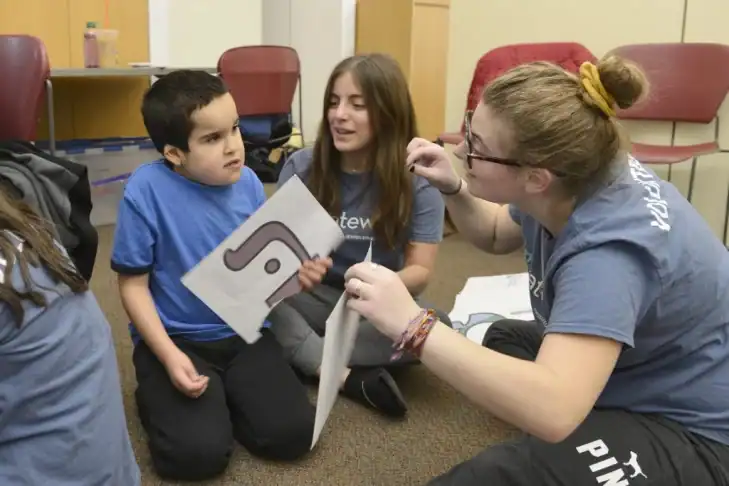
The 31-lesson program combines visual cues, movement and memory techniques to help students connect Hebrew letters with their sounds. Now, thanks to online training, educators anywhere can learn the approach on their own schedules and share with their communities.
“We kept hearing from educators who wanted the training but couldn’t access it,” says Coonley. “Maybe they were the only tutor in their city. Maybe they couldn’t afford live training. Maybe they only had 10 minutes at a time. We realized we needed a way to meet people where they are.”
The approach sprung from a mission to make Hebrew accessible to students with disabilities who were often excluded from traditional Jewish educational settings. Inspired in part by structured literacy approaches used with dyslexic students, the curriculum helps learners create strong connections between the visual shape of a Hebrew letter and the sound it represents. Instead of merely memorizing letters, students engage multiple senses. A letter might be linked with a notable visual feature, a movement or a verbal cue to connect shape with sound.

The roots of the program stretch back to Gateways’ earliest days. Rebecca Redner, an educational specialist at Gateways, was initially impressed by the curriculum as a teen volunteer more than two decades ago.
“When I was 18, I was working with a young man who had autism. He wasn’t able to read in English. He was looking at a picture of the Hebrew letter Bet, which was colored brown, and there was a picture of a brown ball. You could see it click in his head,” Redner recalls.
Additionally, the method teaches Hebrew letters out of alphabetical order. This way, kids can separate letters that are easily confused (bet and vet; shin and sin). Letters are in large print, with wide spacing and a bold font.

“When I learned how to read Hebrew, the teacher would show us the letter and tell us the sound it made, and that was pretty much it,” Redner says. “This is a multi-sensory curriculum. We have a mnemonic trick that helps students zoom into a part of the letter. For example, the letter hé has a hole. Kids might hold their hands up to show a little hole. Taf has a toe—some kids add toenail polish to it when writing. We teach kids to zoom in on the letter’s defining feature.”
The goal is to make decoding Hebrew more concrete and easier to remember. For Redner, the broader message is that Hebrew isn’t inherently harder than English. In many ways, she says, it’s actually simpler.
“In English, letters can make multiple sounds, there are endless exceptions to the rules and decoding can be incredibly complicated,” she explains. “In Hebrew, a letter always makes the same sound.”

The online platform arrives at a time when many Jewish educators are reexamining how Hebrew is taught and whether it unintentionally excludes some learners. Coonley says Hebrew decoding remains one of the most common barriers families encounter when trying to participate in Jewish education overall. Students who can’t read Hebrew may struggle in Hebrew school, day school or in bar and bat mitzvah preparation, limiting their ability to fully engage with Jewish communal life.
“I think the exciting part about this is that there’s a prioritization in the Jewish community right now to make sure that Hebrew is accessible to kids with disabilities,” Coonley says. “We have to make sure Hebrew is accessible for all.”