





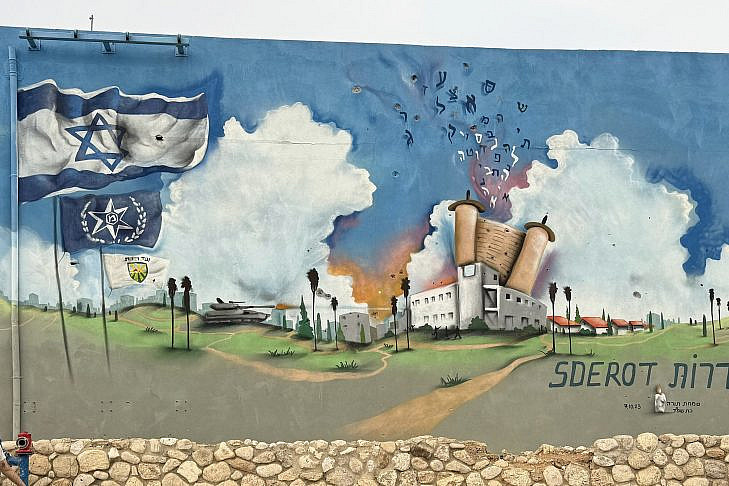
After more than three years, I found myself back in Israel this November. It’s the longest I’ve been away since the 1990s, and to say I was eager to return would be an understatement. I joined a mission with Dror Israel, an organization focused on education, resilience, and renewal, and by the end of the week, I came away with a deeper appreciation of what grassroots Zionism looks like in a country still healing.
Coming to Israel is never a vacation. It’s always more—a pilgrimage, a mission, a reconnection. This time was no different. Over the course of visits to Sderot, Acco, Tel Aviv, Eshbal, Kiryat Shmona, Jisr az-Zarka, Majdal Shams, Haifa, and more, I watched the puzzle pieces of Dror Israel come together: youth movements, schools, social projects, and communities rebuilding from the ground up.
Related
In Sderot, a city that has somehow grown in population since the attacks, we met Itzik, a resident who ran into the streets that morning to protect his neighbors, and Berta, a Ukrainian-Israeli mother who narrowly escaped terrorists who were chasing her. These encounters made it impossible not to feel small as an American Jew, as our friend Barry Shrage said at Hostage Square in Tel Aviv. The scale of loss and the strength to keep going defy comprehension.
Yet amid the grief, there was purpose. We met educators who embody the idea that rebuilding Israel begins with strengthening its people. Dror Israel’s work connects the threads of education, community, and social change into a vision of a more equitable, cohesive society. Their model of urban kibbutzim, schools, an educational philosophy, and a youth movement is an audacious experiment in what 21st-century Zionism can be.
The farther we traveled from Tel Aviv, the clearer it became that the periphery (the border towns and development communities) is where the country’s future is being tested. In Acco, where Arab and Jewish populations coexist uneasily, Dror educators are trying to build bridges in a divided city. In Kiryat Shmona, a town still largely evacuated after a year of war on the northern border, we met young families and educators who left Tel Aviv to help rebuild the region. It’s easy to dismiss the idea of Kiryat Shmona doubling from 25,000 to 50,000, but remember that Tel Aviv was once sand dunes…why can’t we imagine the same transformation there? A.D. Gordon, the philosopher of Labor Zionism, wrote that, “The land of Israel will be built by work.” Watching young educators and families invest themselves in these towns, you see that same spirit; Zionism as a verb, not a noun.
Even in places far from the headlines, we saw quiet heroism. In Majdal Shams, a Druze town on the Syrian border, community leaders described the pain of losing 12 children to a Hezbollah rocket strike and their renewed commitment to connect more deeply with Israeli society. On Kibbutz Eshbal, we met educators living their Zionist dream on a hilltop, blending agricultural work, therapy with animals, and social activism. Everywhere, the message was the same: rebuilding happens one person, one class, one neighborhood at a time.
What struck me most was how Dror Israel is reimagining Zionism not as a historical achievement but as an ongoing project. Their educators, many in their 20s and 30s, live out the values of HaNoar HaOved VeHaLomed, the century-old youth movement that gave birth to Dror. They teach, organize, and build where others might have given up, proving that idealism still has a place in Israel’s story. Berl Katznelson once said, “Zionism is not a dream of escape from reality but a way of facing it.” That line could describe Dror Israel perfectly—their realism is idealism, translated into action.
As former Education Minister Yuli Tamir told us, real transformation starts when people choose to invest in their communities. That’s exactly what Dror is doing—not waiting for political change, but creating it locally. In a country where division and fatigue often dominate, these educators are a reminder that Zionism was never only about founding a state; it was about shaping a society.
By the time we returned to Tel Aviv, we were emotionally and physically spent, but also inspired. The final conversations on the bus were filled with reflections and questions: How can we, from abroad, support this kind of renewal? What does grassroots Zionism look like in our own communities?
Leaving Israel was, as always, bittersweet. The cab ride to Ben Gurion was its own microcosm of Israeli life, as our driver, Yosef, a larger-than-life storyteller, covered everything from politics to Waffle House to the First Lebanon War. Hours later, as the plane lifted into the night sky, I felt the familiar pull of heading home and leaving home at the same time.
I came back from this journey convinced that Dror Israel’s mission to educate, to organize, and to rebuild is one of the most hopeful expressions of Zionism today. In a fractured nation still recovering from October 7, their work offers a reminder that real change starts small, grows locally, and depends on those willing to believe that tomorrow can, indeed, be better.
This post has been contributed by a third party. The opinions, facts and any media content are presented solely by the author, and JewishBoston assumes no responsibility for them. Want to add your voice to the conversation? Publish your own post here. MORE