





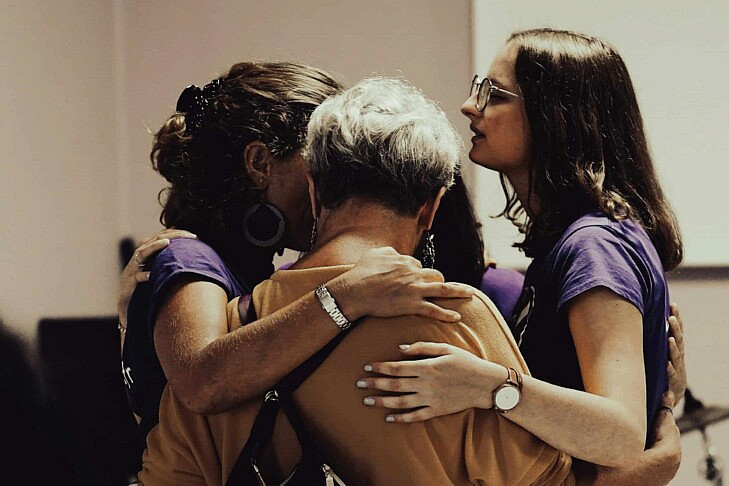
Community can be hard to find these days: We’re busy with work and family; we’re doom-scrolling on our phones; we’re commuting; we’re zoning out to Netflix at the end of a long day. Circles of Connection is an antidote to the modern way of life. These affinity-based support groups, with chapters embedded within synagogues, Hillels or other Jewish organizations throughout Greater Boston, offer a safe space for Jews to gather and discuss difficult topics, from antisemitism in the workplace to illness and grief.
Circles of Connection is a partnership between CJP, Jewish Family & Children’s Service (JF&CS), JCC Greater Boston, The Beker Foundation and The Ruderman Family Foundation. These support groups emerged as a well-being initiative for the Jewish community after the emotional fallout and polarization following Oct. 7, 2023, and the subsequent rise in antisemitism.
Since then, the scope has expanded. Recent chapters have centered on raising trans children or losing a partner. Other groups spring up in response to world events, such as the December 2025 terrorist attack at a Hanukkah event on Bondi Beach in Sydney, Australia. Groups meet in person or virtually on Zoom. Some groups meet multiple times; others are intensive, one-time gatherings that convene in response to current news.
“What’s amazing with Circles of Connection is that, yes, it started with the goal of supporting people around the question of antisemitism, and it’s still available to do that. But it’s also expanded to other types of cohort support,” says Rabbi Allison Berry, director of the Betty Ann Greenbaum Miller Center for Jewish Healing at JF&CS, who oversees the groups.
“After Bondi Beach, we held two different opportunities for groups that were really robust, where people came together to share thoughts, feelings and take care of each other. We’re mobilized whenever there’s any kind of world event.”
Uniquely, the model is peer-led, not therapist-directed. One of the program’s defining features is that groups are facilitated primarily by trained community members rather than clinicians, enhancing the approachable dynamic. About 70 lay facilitators across Greater Boston have been trained to lead conversations and create supportive environments so far.
“The goal is for the groups to be peer-oriented,” Berry says.
Facilitators are nominated through their host organizations, including synagogues and Hillels. Nominees receive extensive trauma-informed training and ongoing supervision. Even though these leaders are also peers, the structure is highly intentional. JF&CS provides clinical oversight, coaching, facilitator check-ins and training in trauma-informed care and group dynamics. Many leaders are rabbis or Jewish educators; each has personal experience with their topic of focus.
“These are people who are very comfortable facilitating and know how to hold a group. It’s really an extraordinary group of people who are very dedicated to thinking deeply about: ‘How do we build supportive spaces in a moment of polarization?’” Berry says.
Although groups are spread across Greater Boston, they follow a consistent, carefully structured format. Every session follows a prescribed framework emphasizing confidentiality, uninterrupted sharing time, emotional safety and listening over debate. Participants typically receive dedicated time to speak without interruption. Confidentiality is required.
“The way that we frame ‘how do we engage together?’ is usually done with very Jewish language, such as confidentiality and not gossiping—lashon hara, for example: not sharing anything that happens in a group. There’s a profound understanding of confidentiality that people should be able to speak their truth and feel cared for within certain boundaries,” Berry explains. “There’s an understanding that we may see things differently, but we’re still part of a community. I think that’s a really profound message at this moment.”
Berry says the groups offer a safe place to utter the unspeakable aloud, such as: “I’m dealing with antisemitism at work, and it’s really jarring or scary.” Or, “I have children fighting in the Israel Defense Forces, and I’m terrified,” she says.
The goal isn’t persuasion or ideological consensus. Participants may hold sharply different views about Israel or Jewish communal issues, but the purpose is to create a space where people feel heard, validated and less isolated.
“Whenever I’m at one of these groups, I believe in other people. We can take care of each other, and listen deeply and meaningfully to one another, even if we don’t always agree. Pockets and spaces for that still exist,” Berry says.
To learn more about starting or joining a group, visit circlesboston.org.