






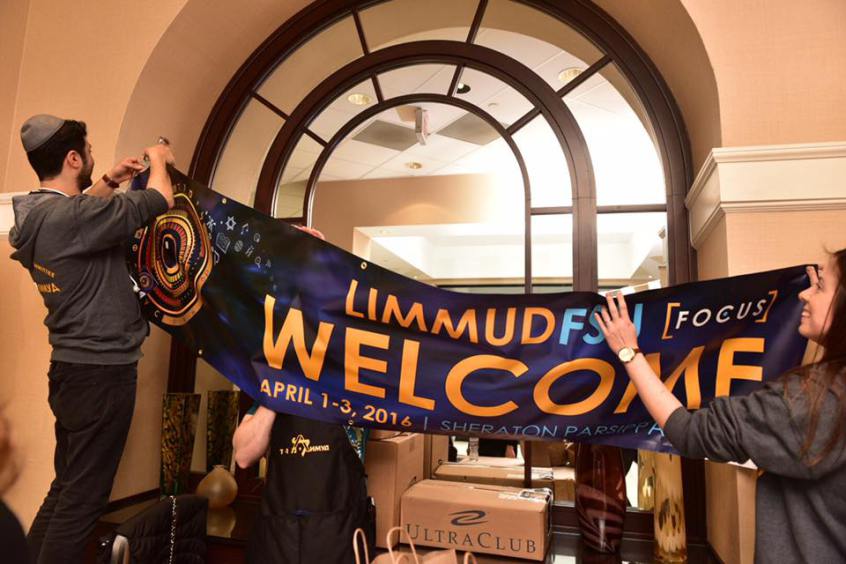
As a first-time presenter and participant at a recent Limmud FSU (Former Soviet Union) I wasn’t entirely sure what to expect. I arrived with a friend to the enormous castle-style Sheraton in New Jersey, excited by the buzz of young Russian Jews setting up the hotel at a frenzied pace. The place was swarming; the welcome sound of Russian bounced off the walls of our castle. The conference had taken over and it felt just right.
 My session, entitled, “Getting Wet: Origins and Evolutions of the Jewish Ritual Bath” began early Saturday morning. As I was getting ready for bed the night before, I genuinely wondered who in their right mind would sign up to learn about mikveh at 9:30 am on a Shabbat morning.
So here’s who showed up to learn about mikveh at 9:30 on a Shabbat morning:
- A two-year-old and her mom
- A 13-year-old and her dad
- Several Orthodox men
- Several Orthodox women
- Several people who believed (all or some of) religion is a lot of baloney
- A young Israeli woman who said mikveh is one of the few Jewish rituals she is drawn to
- My friends, Beata, Misha and Veronica
The effect of many generations, religious backgrounds, and ethnic identities brought every session at Limmud to life. Much like the diverse countries the Soviet regime occupied, Limmud FSU gathered Jews from many parts; Uzbekistan, Azerbaijan, Kazakhstan, Moscow, Israel, Ukraine, Australia, and the United States. All travelling to one imposing castle in New Jersey off of I-287, for a weekend of culture-sharing, laughter, and serious learning.
As we got started at my session, the young girl who came with her father, shared proudly, “I want to know why men go to the mikveh.” Perfect, I thought. “You are in the right place,” I said.
Later, as a fidgety two-year-old wiggled out of her mom’s lap, we discussed the biblical and rabbinic context of niddah, monthly immersion.
Here’s a ‘best of’ selection of some questions that came up: Why did menstruation make you ritually unready to offer a korban, an offering, at the Temple in Jerusalem? Is there something about menstruation that cuts us off from God? Did seminal emission, death, and tzar’at (a biblical disease) render a person tamei (ritually unready) for a similar reason? Why did so many religions decide to separate women during their time of menstruation? What is the relationship between separation and holiness? If both women and men could become ritually unready through natural bodily processes, why don’t men go to the mikveh more often today?
Later, at a lunch of five different types of kosher beef salami, sauerkraut, pickled herring, whitefish salad, and bread, a woman at my table turned to me, “Oh! You are the mikveh lady!”
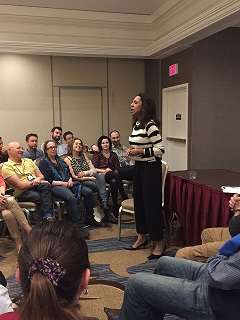 That’s me. And I was thrilled to be the mikveh lady at Limmud FSU. I have rarely felt more pride in my cultural origins than at this conference. I sang and danced during havdalah as a room of 400 adults and children either swayed or jumped to familiar niggunim(wordless melodies); I laughed hard when Yelena Khanga shared stories of working on a Russian television program about sex in the early 90’s. I learned about the history and traditions of Bukhari Jews; sculpted a human head with master teacher, Grigory Gurevich; and learned about Putin’s war against “homofacists” in the Ukraine from journalist and author Masha Gessen. Every session drove home the fact that the Russian Jewish community is literally swelling with brilliant and inspiring individuals. I’m already looking forward to next year.
Leeza Negelev is the Associate Director of Education at Mayyim Hayyim.
This post has been contributed by a third party. The opinions, facts and any media content are presented solely by the author, and JewishBoston assumes no responsibility for them. Want to add your voice to the conversation? Publish your own post here. MORE