





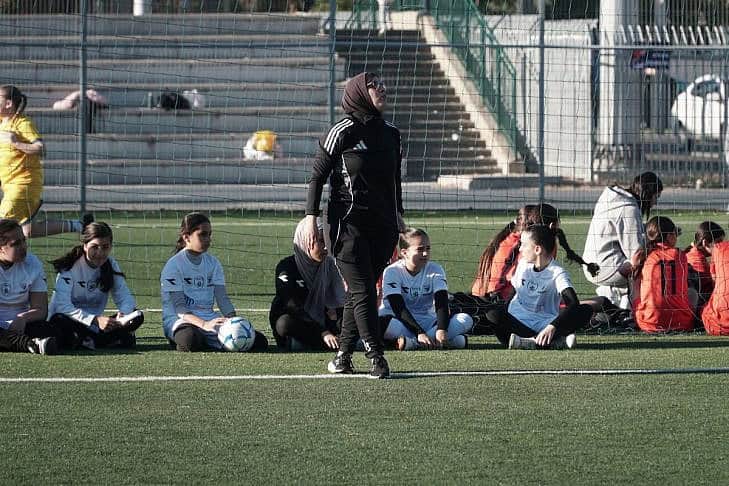
At the Achva School in Haifa’s Wadi Nisnas neighborhood, Sha’ar Shivion, or “The Equalizer,” an organization that runs both sports and educational programming, has launched a special Boatot (girls’ soccer) team this year.
This team of fourth to sixth grade girls from the Arab community in Haifa meets on the pitch twice a week for regular soccer training to improve their skills. In addition to their athletic training, the girls participate in weekly social-educational sessions focused on empowerment.
The Achva team is part of a first-year partnership with CJP’s Haifa-Boston Connection. Through this collaboration, six teams are active across Haifa: three Jewish and three Arab teams.
“This partnership grew out of a broad vision that a healthy and resilient society is one that knows how to connect all its components and create a shared space based on belonging, mutual respect, and coexistence,” said Oshrat Gafni-Moyal, director of the Haifa-Boston partnership. “Sport serves here as a natural platform for human encounter, for developing balanced personal and community identities, and for strengthening the sense of mutual responsibility.”
The Equalizer operates 640 teams across Israel, supporting over 12,000 children and youth. Each team participates in two weekly sports sessions and social-educational session, where values are learned and practiced through the game itself, including responsibility, teamwork, leadership, mutual respect, and self-belief.
The program is centered on providing children with a safe space to develop — socially, physically, and academically — while creating opportunities for meaningful encounters, open communication, and cross-cultural engagement.
The Achva team is led by coach and tutor Hamda Abu-Lail, who knows each girl not just by her position on the field, but by the unique story she brings with her.
“Soccer is just the tool,” Abu-Lail said. “Through the training, they learn how to be a team, even when it’s difficult, even when they don’t win. They stay together.”

One important lesson she’s teaching: To win, you must be a cohesive unit.
“Through the practices, social sessions, and tournaments, they develop patience, tolerance, mutual responsibility, and the ability to truly see one another,” she said.
One of the most significant moments occurred during the year’s first regional tournament. The team traveled together with a team of girls from a Jewish school. During the ride, the girls began to form connections that continued into the tournament.
“They tried to speak in Hebrew, laughed, and asked questions,” Abu-Lail said. “When the other team advanced to the semifinals, my girls stayed to cheer them on. When a player was injured, everyone ran to help her. In a very short time, they were simply friends.”
For many of these girls, who come from challenging socioeconomic backgrounds, the program has become a sanctuary where it’s safe to make mistakes, safe to try, and safe to dream.
“It’s not something to be taken for granted,” Abu-Lail said. “It means they feel there is a place for them here. They wait for practice, ask for more, and want to improve. They are learning that they are allowed to dream, allowed to be on the pitch, and that they belong.”
Itamar Benovich, director of partnerships at The Equalizer, said the effort to use sport as a way of transcending differences was almost immediately apparent.
“This is our first year partnering with CJP, and we are already seeing the impact on the ground,” he said. “We view this partnership as a foundation for collective action that will allow us to expand the circle and provide opportunities for more and more children throughout the city of Haifa.”
Matan Amira, based in Israel, is the director of marketing, communications, and digital at The Equalizer.