





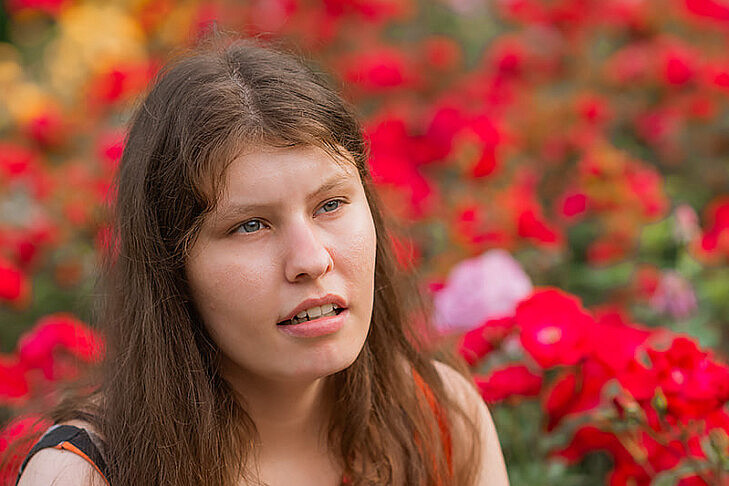
“My name is Alina. I am already 22 years old. I live with my parents, sometimes in Germany, sometimes in Prague, but I miss Kharkiv so much. At least once a week, I have a breakdown, begging to go home.”
Her words are simple, honest, and unfiltered. They do not try to impress — they ask to be heard.
“Hello, kind people,” she writes on her Facebook page. “This is kind Alinochka, greeting you — the kindest, the sweetest.”

“I am very lonely here. I don’t have friends. I’m not allowed to go outside alone because I could get lost, and my parents are at work. I have brothers and sisters, but they are normal and live separately. I want my mommy to always be near me, but she isn’t. I want friends. I hold on to anyone who ever writes to me on Facebook. Sometimes people come and talk to me after reading articles, but they disappear quickly. I can’t let them go. I call them at night, ten times. I need attention, I need communication, but I almost don’t know what to talk about. Order a postcard from me. I will draw you a beautiful Christmas postcard. You will like it. Tell my mom that you want to order one, and she will explain everything…”
Her mother, who helps manage communication and logistics, can be reached here.
And then she asked, quietly but with urgency: “Are you really going to organize an exhibition for me?”
“Draw, Alina. I need a whole notebook of your work.”

And she did.
For nearly half a year, Alina drew. She paused, struggled, and became overwhelmed. There were moments of anger, moments of apathy, moments when she simply did not know what else to draw. And still, she continued. She would message at all hours, day and night, because for her this was not just an exhibition. It was a connection. It was a purpose. It was the possibility of being seen.

This exhibition, “My Name Is Alina,” brings together works by children with autism from Ukraine — those who have been displaced and are now trying to rebuild their lives in unfamiliar countries, and those who remain in Ukraine, continuing their daily lives under the shadow of war. It was organized by Jookender in collaboration with Autism Unity, a nonprofit created in the aftermath of Feb. 24, 2022, dedicated to supporting children with autism affected by the Russian-Ukrainian conflict. Jookender played a role in the early stages of Autism Unity’s creation, providing guidance and support to help establish and launch the organization.
For children with autism and other developmental disabilities, war does not end when they cross a border. In many ways, it becomes even more disorienting. Their sense of safety is deeply tied to routine, familiar environments, and predictable interactions — all of which are suddenly taken away. Even in physically safe countries, they face a constant internal state of confusion, anxiety, and loss. New languages, new systems, new expectations — all without the necessary support structures.
For parents, this becomes a heartbreaking reality. They want to give their children stability, care, and attention, but instead find themselves torn between the need to earn a living and the need to stay physically present for children who depend on them so deeply. They are stretched between survival and caregiving, often without adequate social support, without access to specialized services, and without a community that fully understands their situation. There is a critical shortage of volunteers willing to build consistent, ongoing relationships with these children — not just occasional help, but real, human connection. And yet, one can imagine how transformative it would be to organize volunteer initiatives across the countries where these families have settled, creating opportunities for people to spend time with these children, to engage, to listen, to simply be present. Sometimes, that presence is the most meaningful form of support.
The works presented here are not meant to be evaluated as fine art. They are something else entirely. They are attempts to communicate when words are not enough. They are fragments of inner worlds, drawn in black and white — intentionally left unfinished. We agreed that these works would remain colorless, so each viewer could choose whether to add their own colors or leave them as they are. Sometimes, understanding does not require fixing.
Alongside Alina’s drawings, the exhibition includes prints of works by other children, while original pieces can be requested separately through Autism Unity. But beyond the structure of the exhibition itself, there is a deeper invitation — to see, to pause, and to remember.
It has been four years since the war began, and the fifth is now unfolding. At first, the world responded. People cared, organizations mobilized, and support flowed. But time has passed, and attention has faded. Even Jookender, despite its continued commitment to community, building bridges, and supporting those in need, has recently struggled to raise enough donations to send another round of aid to Ukraine.
One of the goals of this exhibition is to gently restore attention to an issue that is still ongoing, still urgent, and still deeply human. Not through statistics or headlines, but through a voice that is impossible to ignore: “My name is Alina….”
These works may not be considered traditional fine art, but they carry meaning that goes far beyond aesthetics. Children’s organizations, Jewish organizations, and any communities that have supported Ukraine — or wish to continue doing so — can be proud to place these pieces on their walls and invite others to engage with them. In doing so, they help create space for empathy, for conversation, and for renewed awareness.
This exhibition is not just about art. It is about connection. It is about presence. It is about not turning away.
The exhibition will take place at Jookender from May 1-31. It is free and open to the public. Proceeds from any purchased works will be sent directly to the artists’ families.
We are deeply grateful to CJP for continuing to support Jookender and its initiatives, making it possible to carry forward this work and remain present for communities that still need to be seen and heard. We are also sincerely thankful to The Miriam Fund, whose support has been essential in sustaining Jookender’s programs specifically for women and teenage girls who are refugees from the war in Ukraine. These include the online mental health initiative The Tribe, in-person ESL classes, and the advisory support platform — all of which exist thanks to their generous grant.
This post has been contributed by a third party. The opinions, facts and any media content are presented solely by the author, and JewishBoston assumes no responsibility for them. Want to add your voice to the conversation? Publish your own post here. MORE