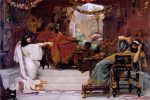





In 2025, I traveled to New York to see “The Book of Esther in the Age of Rembrandt,” a major exhibition at The Jewish Museum. I arrived curious, but with modest expectations. I had always thought of Queen Esther as the heroine of an esoteric Jewish holiday, contained mostly within the world of ritual and Jewish practice.
What I encountered blew my mind.
The exhibition brought together nearly 200 works—paintings, prints, ceremonial objects, and rare books—all inspired by the biblical figure of Esther. Moving through the galleries, it became clear that Esther’s story had reverberations far beyond the Jewish world. During the Renaissance and Baroque periods, artists across Europe returned to her story again and again, depicting her courage, her political acumen, and the dramatic tension of her rise to power. Esther was not only a Jewish heroine, she was a cultural icon, an influencer of the time.
Curator Abigail Rapoport captures this expansive vision: “Esther’s story resonated deeply in early modern Europe because it speaks to power, identity, and survival. Artists saw in her a figure who could embody both vulnerability and strength. The duality of private identity and public courage made Esther a compelling subject in an era grappling with questions of faith, authority, and belonging.”
The exhibition itself has taken on a journey worthy of its subject. After debuting at The Jewish Museum in New York, it traveled to the North Carolina Museum of Art, and now arrives in Boston at the Isabella Stewart Gardner Museum. Each venue offers a distinct perspective, shaped by its own collection and context.
One of the most remarkable revelations for me was learning that the Gardner’s own iconic self-portrait masterpiece by Rembrandt van Rijn, never before removed from the walls of the Gardner, went on loan for the first time to be part of this exhibit. The first-time loan of this iconic painting underscored the significance of the show and the centrality of Esther’s story within Rembrandt’s work. Now, as the exhibition arrives in Boston, the painting returns home, offering local audiences a chance to see it in dialogue with a broader artistic and historical narrative.
Yet for all their beauty and drama, many of these works only partially tell the Jewish story behind Esther. Created largely by Christian artists for Christian audiences, they often emphasize universal themes while leaving the deeper layers of Jewish tradition and interpretation in the background.
That is where the partnership with Vilna Shul comes in. As Boston’s Center for Jewish Culture, The Vilna brings an interpretive lens to this exhibition. Together, the Gardner and The Vilna present a season of programs designed to deepen and expand the story of Esther, reclaiming her Jewish context while celebrating her broader cultural impact. As exhibit curator Diana Seave Greenwald reflects: “Esther is a heroine we all need for this moment. The intersection of Jewish identity and the Gardner collection makes this exhibition especially powerful for me personally.” Throughout the run of the show, audiences will be invited to explore Esther’s story from multiple perspectives. Former CJP x Vilna Community Creative Fellow and digital storyteller influencer Miriam Anzovin will delve into the Talmudic layers of Esther’s narrative, unpacking how rabbinic tradition reimagines her as a complex and even subversive figure. Performances by artists like musician Galeet Dardashti will evoke the Persian cultural world from which Esther’s story emerges, offering an auditory journey into her historical landscape. A highlight of the series will be “Curating Esther,” a conversation hosted at The Vilna Shul featuring the three female curators who shaped the exhibition across its three venues, including creator Abigail Rapoport. Their dialogue promises to illuminate not only the art itself but also the contemporary resonance of Esther’s story—how it continues to inspire questions about gender, power, and identity. Esther is a woman navigating multiple identities. A figure of hiddenness and revelation. A heroine whose courage lies not in physical strength, but in timing, intelligence, and moral clarity. In a moment when questions of identity and belonging feel especially urgent, Esther’s story feels newly relevant. Through the exhibit and programming, I’m eager for the many facets of understanding Esther, not only as a figure of the past, but as the living symbol we need today. Find a full calendar of events at The Gardner and The Vilna throughout the exhibition.
This post has been contributed by a third party. The opinions, facts and any media content are presented solely by the author, and JewishBoston assumes no responsibility for them. Want to add your voice to the conversation? Publish your own post here.
MORE
Related